13 Mayıs 2014 Salı
Turkey to become Associate Member State of CERN
Geneva, 12 May 2014. CERN1 Director General Rolf Heuer and Mr Taner Yildiz, Minister for Energy and Natural Resources of the Republic of Turkey today signed an agreement admitting Turkey to CERN Associate Membership, subject to ratification by the Grand National Assembly of Turkey, the Meclis.
“The Turkish scientific community has a long and proud history of involvement with CERN’s programmes stretching back over 40 years,” said Professor Heuer, “it is therefore a great pleasure, and an honour for me to cement that relationship with today’s signature.”
“This is a very special moment for Turkey and Turkish scientific community”, said Mr Yildiz. “Today we signed the agreement for "Associate Membership" to CERN, which reflects decades of achievement where Turkish scientists have contributed to the European scientific efforts at CERN. I am fully confident that with this signature, the relations between Turkey and CERN will further develop on a win-win basis.”
Turkey was granted Observer Status at CERN in 1961. In 2008 a Co-operation Agreement between CERN and the Turkish Atomic Energy Authority (TAEK) was signed concerning the further development of scientific and technical cooperation in high-energy physics. Turkish physicists have participated in a number of CERN experiments over recent years, notably CHORUS where they made several important contributions to data analysis.
Today, Turkish physicists are active in the ALICE, ATLAS, CMS and LHCb experiments at the LHC, and are also involved with the CAST, NA63 and OPERA experiments as well as experiments at the ISOLDE facility. Turkey operates a Tier-2 centre of the Worldwide LHC Computing Grid, and some 110 Turkish scientists are registered users of CERN’s facilities.
Turkey’s Associate Membership will strengthen the long-term partnership between CERN and the Turkish scientific community. Associate Membership will allow Turkey to attend meetings of the CERN Council. Moreover, it will allow Turkish scientists to become members of the CERN staff, and to participate in CERN’s training and career development programs. Finally, it will allow Turkish industry to bid for CERN contracts, thus opening up opportunities for industrial collaboration in areas of advanced technology.
Footnote(s):
1. CERN, the European Organization for Nuclear Research, is the world's leading laboratory for particle physics. It has its headquarters in Geneva. At present, its member states are Austria, Belgium, Bulgaria, the Czech Republic, Denmark, Finland, France, Germany, Greece, Hungary, Israel, Italy, the Netherlands, Norway, Poland, Portugal, Slovakia, Spain, Sweden, Switzerland and the United Kingdom. Romania is a Candidate for Accession. Serbia is an Associate Member in the pre-stage to Membership. India, Japan, the Russian Federation, the United States of America, Turkey, the European Commission and UNESCO have observer status. Once Turkey’s new status as an Associate Member becomes effective, its Observer Status will come to an end.


10 Mayıs 2014 Cumartesi
10-theoretical-particles-that-could-explain-everything/
For ages, humankind has dug into the mysteries surrounding the exact composition of the universe. Ancient Greeks were the first to surmise the existence of atoms, which they believed to be the smallest particles in the universe—the “building blocks” of everything. For about 1,500 years, that was the most we knew about matter. Then, in 1897, the discovery of the electron left the scientific world in a shambles. Just as molecules were made of atoms, now the atoms appeared to have their own ingredients.And the deeper we looked, the more the answers seemed to flit through our fingertips, always out of reach. Even protons and neutrons—the building blocks of atoms—are made of ever-smaller pieces called quarks. Every discovery just seems to raise more questions. Are time and space just bundles and clusters of little charged crumbs too small to even see? Maybe—but then again, these ten theoretical particles could explain everything. If we could actually find them:10
Strangelets
Neutron-StarLet’s start with something closest to what we already know—quarks. There is more than one type of quark: six, to be exact. “Up” and “down” quarks are the most common types, and these are what build into the protons and neutrons of atoms. “Strange” quarks, on the other hand, aren’t so common. When strange quarks combine with up and down quarks in equal numbers, they create a particle called a strangelet, and strangelets are the wispy fragments that build into strange matter.Now, according to the strange matter hypothesis, strangelets are created in nature when a massive neutron star—a high-mass collapsed star—builds so much pressure that the electrons and protons in its core fuse together, then collapse further into sort of a dense quark bubble, which we call strange matter. And since large strangelets can theoretically exist outside of those high pressure center-of-a-star environments, it’s likely that they’ve floated away from those stars and into other solar systems—including our own.And this is where it gets crazy: if these things did exist, a large strangelet would be able to convert an atom’s nucleus into another strangelet by colliding with it. The new strangelet could then collide with more nuclei, converting them into more strangelets in a chain reaction until all the matter on Earth had been converted into strange matter. In fact, the Large Hadron Collider facility had to put out a press release stating that they were unlikely to accidentally create strangelets that could destroy the planet. That’s how seriously the scientific community takes the matter of strangelets.9
Sparticles
Susy1The theory of supersymmetry states that every particle in the universe has an opposite twin particle—known as a supersymmetric particle, or sparticle. So for every quark out there, there’s a sister—a squark—that shares perfect symmetry with it. For every photon, there’s a photino. And so on for all sixty-one known elementary particles. So if there are so many of them, why haven’t we discovered any of these sparticles yet?Here’s the theory: in particle physics, heavier particles decay faster than lighter particles. If a particle gets heavy enough, it breaks down almost immediately once it’s created. So assuming the sparticles are incredibly heavy, they would break down in the blink of an eye, while their superpartners—the particles we can see and observe—live on. This could also explain why there’s so much matter in the universe yet precious little dark matter, because the sparticles could comprise dark matter and exist in a field which is—so far—unobservable.8
Antiparticles
Switzerland-God-Parti DargMatter is made of particles—and in a similar way, antimatter is made of antiparticles. This all makes sense, right? Antiparticles have the same mass as normal particles, but an opposite charge and an opposite angular momentum (spin). It sounds like the supersymmetry theory, but unlike particles, antiparticles behave just like particles—even building into anti-elements, like antihydrogen. Basically, all matter has corresponding antimatter. Or at least, it should. That’s the problem—there’s plenty of matter around, but antimatter just doesn’t really show up anywhere. (Except the Large Hadron Collider—full disclosure, antiparticles have been found and are no longer theoretical).During the Big Bang, there should have been equal numbers of particles and antiparticles. The idea is that all matter in the universe was created at that point. So by default, all antimatter had to be created at the same time. One theory is that there are other parts of the universe dominated by antimatter. Everything we can see, even the most distant stars, is mostly matter. But our visible universe could only be one small section of the universe, while antimatter planets and suns and galaxies swarm in a different sphere of the universe, like opposite-charged electrons and protons revolving around each other in an atom.7
Gravitons
Galaxy SpacewarpRight now, antiparticles are a huge problem in current particle physics theories. Care to hear about another problem? Gravity. Compared to other forces, like electromagnetism, gravity is weaker than sneezing your way through a fist fight. It also seems to change its nature based on the mass of an object—gravity is easy to observe in planets and stars, but get it down to the molecular level and it seems to do whatever it wants. And in additional to all that, it doesn’t even have a particle to carry it, like the photons that carry light. That’s where the graviton comes in. The graviton is the theoretical particle that would—sort of—allow gravity to fit in the same model as every other observable force. Because gravity exerts a weak pull on every object, regardless of distance, it would have to be massless. But that’s not the problem—photons are massless and they’ve been found. We’ve gone so far as to define the exact parameters that a graviton would have to fit into, and as soon as we find a particle—any particle—that matches those parameters, we’ll have a graviton.Finding it would be important because, as of now, general relativity and quantum physics are incompatible. But at a certain precise energy level, known as the Planck scale, gravity stops following relativity rules and slips into quantum rules. So solving the gravity problem could be the key to a unified theory.6
Graviphotons
GravityThere’s another theoretical gravitation particle, and it’s absolutely beautiful. The graviphoton is a particle that would be created when the gravitational field is excited in a fifth dimension. It comes from the Kaluza Klein theory, which proposes that electromagnetism and gravitation can be unified into a single force under the condition that there are more than four dimensions in spacetime. A graviphoton would have the characteristics of a graviton, but it would also carry the properties of a photon and create what physicists call a “fifth force” (there are currently four fundamental forces).Other theories state that a graviphoton would be a superpartner (like a sparticle) of gravitons, but that it would actually attract and repel at the same time. By doing that, gravitons could theoretically create anti-gravity. And that’s only in the fifth dimension—the theory of supergravity also posits the existence of graviphotons, but allows for eleven dimensions.
5
Preons
551343 351705898263844 1360877133 NWhat are quarks made of? First of all, let’s get an idea of scale. The nucleus of a gold atom has seventy-nine protons. Each proton is made of three quarks. Now, the width of that gold atom’s nucleus is about eight femtometers across. That’s eight millionths of a nanometer, and a nanometer is already one billionth of a meter. So let’s just agree that quarks are small, and realize that preons—sub-quark particles—would have to be so infinitesimally small that there is no scale right now which could measure their size.There are other words used to describe the theoretical building blocks of quarks, including primons, subquarks, quinks, and tweedles, but “preon” is generally the most accepted. And preons are important because right now, quarks are a fundamental particle—they’re as low as you can go. If they were found to be composite, or made of other pieces, it could open the door to thousands of new theories. For example, one theory right now states that the universe’s elusive antimatter is actually contained in preons, and therefore everything has bits of antimatter locked inside it. According to this theory, you’re part antimatter yourself—you just can’t see it because the matter pieces build into bigger blocks.4
Tachyons
Speed Of Light By Fx 1988Nothing comes closer to breaching the known laws of relativity than a tachyon. It’s a particle that moves faster than light, and if it existed it would suggest that the lightspeed barrier is . . . well, no longer a barrier. In fact, it would mean that the speed we know of as the speed of light would be the center point—just as normal particles can move infinitely slow (not moving at all), a tachyon existing on the other side of the barrier would be able to move infinitely fast.Bizarrely, their relationship to the speed of light would be mirrored. To put it simply, when a normal particle speeds up, its energy needs increase. To actually break through the lightspeed barrier, its energy needs would rise to infinity—it would need infinite energy. For a tachyon, the slower it goes, the more energy it needs. As it slows and approaches the speed of light from the other side, its energy requirements become infinite. But when it speeds up, the energy requirements decrease, until it needs no energy at all to move at infinite speed.Think of it like a magnet—you have one magnet taped to a wall, and another in your hand. When you push your magnet towards the wall with the poles aligned, your magnet is repelled. The closer you put it, the harder you need to push. Now imagine on the other side of the wall is another magnet, doing the same thing. The wall magnet is the speed of light, and the two magnets are tachyons and normal particles. So even if tachyons did exist, they would be forever trapped on the opposite side of a barrier which we ourselves can’t pass. Although, we’ve forgotten to mention that they could technically be harnessed to send messages into the past.3
Strings
String Theory By Aeron XNearly all of the particles we’ve talked about so far are called point particles; quarks and photons exist as a single point—a tiny little dot, if you will—with zero dimensions. String theory suggests that these elementary particles aren’t actually points at all—they’re strings, one dimensional particle strands. At its core, string theory is a Theory of Everything that manages to coexist with both gravity and quantum physics (based on what we know right now, those two can’t physically exist in the same space—gravity doesn’t work at the quantum level).So in a broad sense, string theory is actually a quantum theory of gravity. And for comparison, strings would replace preons as the building blocks of quarks while at higher levels everything remains the same. And in string theory, the string can turn into anything based on the way it’s shaped. If the string is an open strand, it becomes a photon. If the ends of that same string connect and form a loop, it becomes a graviton—in much the same way that the same piece of wood can become either a house or a flute.There are actually multiple string theories, and interestingly, each one predicts a different number of dimensions. Most of these theories state that there are ten or eleven dimensions, while Bosonic string theory (or superstring theory) calls for no less than twenty-six. In these other dimensions, gravity would have an equal or greater strength than other fundamental forces, explaining why it’s so weak in our three spatial dimensions.2
Branes
Multiverse-1If you really want an explanation of gravity, you have to look to M-theory, or Membrane theory. Membranes, or branes, are particles that are able to encompass multiple dimensions. For example, a 0-brane is a point-like brane that exists in zero dimensions, like a quark. A 1-brane has one dimension—a string. A 2-brane is a two-dimensional membrane, and so on. Higher dimensional branes can have any size—leading to the theory that our universe is really one large brane with four dimensions. That brane—our universe—is just a piece of multi-dimensional space.And as for gravity, our four-dimensional brane can’t simply contain it, so gravity’s energy leaks into other branes as it passes them in the multi-dimensional space; we just have the dribbles of what’s left, which is why it seems so weak compared to other forces.Extrapolating that, it makes sense that there are many branes moving through this space—infinite branes in an infinite space. And from there we have the multiverse and cyclic universe theories. The latter states that the universe cycles itself: it expands from the energy of the Big Bang, then gravity pulls everything back into the same space for the Big Crunch. That compression energy sets off another Big Bang, bouncing the universe into another cycle, like a cell flaring into life and then dying.1
God Particle
Screen Shot 2013-05-03 At 5.24.58 PmThe Higgs boson, more commonly known as the God particle, was tentatively found on March 14, 2013, in the Large Hadron Collider (9). As a little bit of background, the Higgs boson was first hypothesized in the 1960s as the particle that gives mass to other particles.Basically, the God particle is produced in the Higgs field and was proposed as a way to explain why some particles that should have had mass were actually massless. The Higgs field—which had never been observed—would have to exist throughout the universe and provide the force needed for particles to acquire their mass. And if that were true, it would fill huge gaps in the Standard Model, which is the basic explanation of literally everything (except, as always, gravity).The Higgs boson is vital because it proves that the Higgs field exists, and explains how energy inside the Higgs field can manifest as mass. But it’s also important because it sets a precedent; before it was discovered, the Higgs boson was just a theory. It had mathematical models, physical parameters that would allow it to exist, how it should spin—everything. We just didn’t have any evidence of its existence whatsoever. But based on those models and theories, we were able to pinpoint a specific particle—the smallest thing in the known universe—that matched everything we’d hypothesized.If we can do it once, who’s to say that any of these particles couldn’t be real? Tachyons, strangelets, gravitons—particles that would shift everything we know about life and the universe and bring us closer to actually understanding the fundamentals of the world we live in.ANDREW HANDLEY
Andrew is a freelance writer and the owner of the sexy, sexy HandleyNation Content Service. When he's not writing he's usually hiking or rock climbing, or just enjoying the fresh North Carolina air.
Read More: Twitter Facebook Social Media HandleyNation
23 Haziran 2011 Perşembe
When Matter Melts


When Matter MeltsBy comparing theory with data from STAR, Berkeley Lab scientists and theircolleagues map phase changes in the quark-gluon plasmaIn its infancy, when the universe was a few millionths of a second old,the elemental constituents of matter moved freely in a hot, dense soup ofquarks and gluons. As the universe expanded, this quark–gluon plasmaquickly cooled, and protons and neutrons and other forms of normal matter"froze out": the quarks became bound together by the exchange of gluons,the carriers of the color force."The theory that describes the color force is called quantumchromodynamics, or QCD," says Nu Xu of the U.S. Department of Energy'sLawrence Berkeley National Laboratory (Berkeley Lab), the spokesperson forthe STAR experiment at the Relativistic Heavy Ion Collider (RHIC) at DOE’sBrookhaven National Laboratory. "QCD has been extremely successful atexplaining interactions of quarks and gluons at short distances, such ashigh-energy proton and antiproton collisions at Fermi National AcceleratorLaboratory. But in bulk collections of matter - including the quark-gluonplasma - at longer distances or smaller momentum transfer, an approachcalled lattice gauge theory has to be used."Until recently, lattice QCD calculations of hot, dense, bulk matter couldnot be tested against experiment. Beginning in 2000, however, RHIC wasable to recreate the extreme conditions of the early universe inminiature, by colliding massive gold nuclei (heavy ions) at high energies.Experimentalists at RHIC, working with theorist Sourendu Gupta of India'sTata Institute of Fundamental Research, have recently comparedlattice-theory predictions about the nature of the quark-gluon plasma withcertain STAR experimental results for the first time. In so doing theyhave established the temperature boundary where ordinary matter and quarkmatter cross over and change phase. Their results appear in the journalScience.Phase diagramsThe aim of both the theoretical and experimental work is to explore andfix key points in the phase diagram for quantum chromodynamics. Phasediagrams are maps, showing, for example, how changes in pressure andtemperature determine the phases of water, whether ice, liquid, or vapor.A phase diagram of QCD would map the distribution of ordinary matter(known as hadronic matter), the quark-gluon plasma, and other possiblephases of QCD such as color superconductivity."Plotting a QCD phase diagram requires both theory calculations andexperimental effort with heavy-ion collisions," says Xu, who is a memberof Berkeley Lab's Nuclear Science Division and an author of the Sciencepaper. Experimental studies require powerful accelerators like RHIC onLong Island or the Large Hadron Collider at CERN in Geneva, whilecalculations of QCD using lattice gauge theory require the world's biggestand fastest supercomputers. Direct comparisons can achieve more thaneither approach alone.One of the basic requirements of any phase diagram is to establish itsscale. A phase diagram of water might be based on the Celsius temperaturescale, defined by the boiling point of water under normal pressure (i.e.,at sea level). Although the boiling point changes with pressure - athigher altitudes water boils at lower temperatures - these changes aremeasured against a fixed value.The scale of the QCD phase diagram is defined by a transition temperatureat the zero value of "baryon chemical potential." Baryon chemicalpotential measures the imbalance between matter and antimatter, and zeroindicates perfect balance.Through extensive calculations and actual data from the STAR experiment,the team was indeed able to establish the QCD transition temperature.Before they could do so, however, they first had to realize an equallysignificant result, showing that the highly dynamical systems of RHIC'sgold-gold collisions, in which the quark-gluon plasma winks in and out ofexistence, in fact achieve thermal equilibrium. Here’s where theory andexperiment worked hand in hand."The fireballs that result when gold nuclei collide are all different,highly dynamic, and last an extremely short time," says Hans Georg Ritter,head of the Relativistic Nuclear Collisions program in Berkeley Lab'sNuclear Science Division and an author of the Science paper. Yet becausedifferences in values of the kind observed by STAR are related tofluctuations in thermodynamic values predicted by lattice gauge theory,says Ritter, "by comparing our results to the predictions of theory, wehave shown that what we measure is in fact consistent with the fireballsreaching thermal equilibrium. This is an important achievement."The scientists were now able to proceed with confidence in establishingthe scale of the QCD phase diagram. After a careful comparison betweenexperimental data and the results from the lattice gauge theorycalculations, the scientists concluded that the transition temperature(expressed in units of energy) is 175 MeV (175 million electron volts).Thus the team could develop a "conjectural" phase diagram that showed theboundary between the low-temperature hadronic phase of ordinary matter andthe high-temperature quark-gluon phase.In search of the critical pointLattice QCD also predicts the existence of a "critical point." In a QCDphase diagram the critical point marks the end of a line showing where thetwo phases cross over, one into the other. By changing the energy, forexample, the baryon chemical potential (balance of matter and antimatter)can be adjusted.Among the world's heavy-ion colliders, only RHIC can tune the energy ofthe collisions through the region of the QCD phase diagram where thecritical point is most likely to be found - from an energy of 200 billionelectrons volts per pair of nucleons (protons or neutrons) down to 5billion electron volts per nucleon pair.Says Ritter, "Establishing the existence of a QCD critical point would bemuch more significant than setting the scale." In 2010, RHIC started aprogram to search for the QCD critical point.Xu says, "In this paper, we compared experimental data with latticecalculations directly, something never done before. This is a real stepforward and allows us to establish the scale of the QCD phase diagram.Thus begins an era of precision measurements for heavy-ion physics.""Scale for the phase diagram of quantum chromodynamics," by SourenduGupta, Xiaofeng Luo, Bedangadas Mohanty, Hans Georg Ritter, and Nu Xu,appears in the 24 June 2011 issue of Science magazine. Gupta is with theTata Institute of Fundamental Research in Mumbai, India, where thetheoretical calculations for this paper were carried out. Mohanty is withthe Variable Energy Cyclotron Centre in Kolkata, India, and was formerly apostdoctoral fellow at Berkeley Lab. Luo, Ritter, and Xu are with BerkeleyLab’s Nuclear Science Division. Luo is also with the University of Scienceand Technology of China in Hefei, and Xu is also with the Central ChinaNormal University in Wuhan. This work was supported by the Indian LatticeGauge Theory Initiative, by India's Department of Atomic Energy-Board ofResearch in Nuclear Sciences, the National Science Foundation of China,the Chinese Ministry of Education, and by DOE’s Office of Science.Lawrence Berkeley National Laboratory addresses the world's most urgentscientific challenges by advancing sustainable energy, protecting humanhealth, creating new materials, and revealing the origin and fate of theuniverse. Founded in 1931, Berkeley Lab's scientific expertise has beenrecognized with 12 Nobel prizes. The University of California managesBerkeley Lab for the U.S. Department of Energy’s Office of Science. Formore, visit www.lbl.gov.An html version of this release, with downloadable images, is athttp://newscenter.lbl.gov/news-releases/2011/06/23/when-matter-melts/
Is Dark Matter Rather Than Light a Basic for Organic Life?

Is Dark Matter Rather Than Light a Basic for Organic Life?
The NASA Hubble Space Telescope image above shows the distribution of dark matter in the center of the giant galaxy cluster Abell 1689, containing about 1,000 galaxies and trillions of stars. A new study suggests that mysterious, invisible dark matter could warm millions of starless planets in regions such as Abell 1689 and make them habitable.Scientists think the invisible, as-yet-unidentified dark matter which we know exists because of the gravitational effects it has on galaxies, makes up about 85 percent of all matter in the universe.Current prime candidates for what dark matter might be are massive particles that only rarely interact with normal matter. These particles could be their own antiparticles, meaning they annihilate each other when they meet, releasing energy. These invisible particles could get captured by a planet's gravity and unleash energy that could warm that world, according to physicist Dan Hooper and astrophysicist Jason Steffen at the Fermi National Accelerator Laboratory.Hooper and Steffen's propose that rocky "super-Earths" in regions with high densities of slow-moving dark matter could be warmed enough to keep liquid water on their surfaces, even in the absence of additional energy from starlight or other sources.The density of dark matter is expected to be hundreds to thousands of times greater in the innermost regions of the Milky Way and in the cores of dwarf spheroidal galaxies than it is in our solar system.The scientists concluded that on planets in dense "dark-matter" regions, it may be dark matter rather than light that creates the basic elements you need for organic life without a star"Dark matter, the team believes, could keep the surfaces of such warm for trillions of years, outliving all regular stars and may ultimately prove to be the "dark" bastion of life in our universe."I imagine 10 trillion years in the future, when the universe has expanded beyond recognition and all the stars in our galaxy have long since burnt out, the only planets with any heat are these here, and I could imagine that any civilization that survived over this huge stretch of time would start moving to these dark-matter-fueled planets," Hooper said in an interview with space.com.Provided by The Daily Galaxy - astrophysical journal
The NASA Hubble Space Telescope image above shows the distribution of dark matter in the center of the giant galaxy cluster Abell 1689, containing about 1,000 galaxies and trillions of stars. A new study suggests that mysterious, invisible dark matter could warm millions of starless planets in regions such as Abell 1689 and make them habitable.Scientists think the invisible, as-yet-unidentified dark matter which we know exists because of the gravitational effects it has on galaxies, makes up about 85 percent of all matter in the universe.Current prime candidates for what dark matter might be are massive particles that only rarely interact with normal matter. These particles could be their own antiparticles, meaning they annihilate each other when they meet, releasing energy. These invisible particles could get captured by a planet's gravity and unleash energy that could warm that world, according to physicist Dan Hooper and astrophysicist Jason Steffen at the Fermi National Accelerator Laboratory.Hooper and Steffen's propose that rocky "super-Earths" in regions with high densities of slow-moving dark matter could be warmed enough to keep liquid water on their surfaces, even in the absence of additional energy from starlight or other sources.The density of dark matter is expected to be hundreds to thousands of times greater in the innermost regions of the Milky Way and in the cores of dwarf spheroidal galaxies than it is in our solar system.The scientists concluded that on planets in dense "dark-matter" regions, it may be dark matter rather than light that creates the basic elements you need for organic life without a star"Dark matter, the team believes, could keep the surfaces of such warm for trillions of years, outliving all regular stars and may ultimately prove to be the "dark" bastion of life in our universe."I imagine 10 trillion years in the future, when the universe has expanded beyond recognition and all the stars in our galaxy have long since burnt out, the only planets with any heat are these here, and I could imagine that any civilization that survived over this huge stretch of time would start moving to these dark-matter-fueled planets," Hooper said in an interview with space.com.Provided by The Daily Galaxy - astrophysical journal
14 Aralık 2010 Salı
Astronomers Find First Evidence Of Other Universes
Astronomers Find First Evidence Of Other Universes
Our cosmos was "bruised" in collisions with other universes. Now astronomers have found the first evidence of these impacts in the cosmic microwave background
There's something exciting afoot in the world of cosmology. Last month, Roger Penrose at the University of Oxford and Vahe Gurzadyan at Yerevan State University in Armenia announced that they had found patterns of concentric circles in the cosmic microwave background, the echo of the Big Bang.
This, they say, is exactly what you'd expect if the universe were eternally cyclical. By that, they mean that each cycle ends with a big bang that starts the next cycle. In this model, the universe is a kind of cosmic Russian Doll, with all previous universes contained within the current one.
That's an extraordinary discovery: evidence of something that occurred before the (conventional) Big Bang.
Today, another group says they've found something else in the echo of the Big Bang. These guys start with a different model of the universe called eternal inflation. In this way of thinking, the universe we see is merely a bubble in a much larger cosmos. This cosmos is filled with other bubbles, all of which are other universes where the laws of physics may be dramatically different to ours.
These bubbles probably had a violent past, jostling together and leaving "cosmic bruises" where they touched. If so, these bruises ought to be visible today in the cosmic microwave background.
Now Stephen Feeney at University College London and a few pals say they've found tentative evidence of this bruising in the form of circular patterns in cosmic microwave background. In fact, they've found four bruises, implying that our universe must have smashed into other bubbles at least four times in the past.
Again, this is an extraordinary result: the first evidence of universes beyond our own.
So, what to make of these discoveries. First, these effects could easily be a trick of the eye. As Feeney and co acknowledge: "it is rather easy to fifind all sorts of statistically unlikely properties in a large dataset like the CMB." That's for sure!
There are precautions statisticians can take to guard against this, which both Feeney and Penrose bring to bear in various ways.
But these are unlikely to settle the argument. In the last few weeks, several groups have confirmed Pernose's finding while others have found no evidence for it. Expect a similar pattern for Feeney's result.
The only way to settle this will be to confirm or refute the findings with better data. As luck would have it, new data is forthcoming thanks to the Planck spacecraft that is currently peering into the cosmic microwave background with more resolution and greater sensitivity than ever.
Cosmologists should have a decent data set to play with in a couple of years or so. When they get it, these circles should either spring into clear view or disappear into noise (rather like the mysterious Mars face that appeared in pictures of the red planet taken by Viking 1 and then disappeared in the higher resolution shots from the Mars Global Surveyor).
Planck should settle the matter; or, with any luck, introduce an even better mystery. In the meantime, there's going to be some fascinating discussion about this data and what it implies about the nature of the Universe. We'll be watching.
Ref:
http://arxiv.org/abs/1012.1995: First Observational Tests of Eternal Inflation
http://arxiv.org/abs/1011.3706: Concentric Circles In WMAP Data May Provide Evidence Of Violent Pre-Big-Bang Activity
Our cosmos was "bruised" in collisions with other universes. Now astronomers have found the first evidence of these impacts in the cosmic microwave background
There's something exciting afoot in the world of cosmology. Last month, Roger Penrose at the University of Oxford and Vahe Gurzadyan at Yerevan State University in Armenia announced that they had found patterns of concentric circles in the cosmic microwave background, the echo of the Big Bang.
This, they say, is exactly what you'd expect if the universe were eternally cyclical. By that, they mean that each cycle ends with a big bang that starts the next cycle. In this model, the universe is a kind of cosmic Russian Doll, with all previous universes contained within the current one.
That's an extraordinary discovery: evidence of something that occurred before the (conventional) Big Bang.
Today, another group says they've found something else in the echo of the Big Bang. These guys start with a different model of the universe called eternal inflation. In this way of thinking, the universe we see is merely a bubble in a much larger cosmos. This cosmos is filled with other bubbles, all of which are other universes where the laws of physics may be dramatically different to ours.
These bubbles probably had a violent past, jostling together and leaving "cosmic bruises" where they touched. If so, these bruises ought to be visible today in the cosmic microwave background.
Now Stephen Feeney at University College London and a few pals say they've found tentative evidence of this bruising in the form of circular patterns in cosmic microwave background. In fact, they've found four bruises, implying that our universe must have smashed into other bubbles at least four times in the past.
Again, this is an extraordinary result: the first evidence of universes beyond our own.
So, what to make of these discoveries. First, these effects could easily be a trick of the eye. As Feeney and co acknowledge: "it is rather easy to fifind all sorts of statistically unlikely properties in a large dataset like the CMB." That's for sure!
There are precautions statisticians can take to guard against this, which both Feeney and Penrose bring to bear in various ways.
But these are unlikely to settle the argument. In the last few weeks, several groups have confirmed Pernose's finding while others have found no evidence for it. Expect a similar pattern for Feeney's result.
The only way to settle this will be to confirm or refute the findings with better data. As luck would have it, new data is forthcoming thanks to the Planck spacecraft that is currently peering into the cosmic microwave background with more resolution and greater sensitivity than ever.
Cosmologists should have a decent data set to play with in a couple of years or so. When they get it, these circles should either spring into clear view or disappear into noise (rather like the mysterious Mars face that appeared in pictures of the red planet taken by Viking 1 and then disappeared in the higher resolution shots from the Mars Global Surveyor).
Planck should settle the matter; or, with any luck, introduce an even better mystery. In the meantime, there's going to be some fascinating discussion about this data and what it implies about the nature of the Universe. We'll be watching.
Ref:
http://arxiv.org/abs/1012.1995: First Observational Tests of Eternal Inflation
http://arxiv.org/abs/1011.3706: Concentric Circles In WMAP Data May Provide Evidence Of Violent Pre-Big-Bang Activity
1 Temmuz 2010 Perşembe
X-ray Discovery Points to Location of Missing Matter
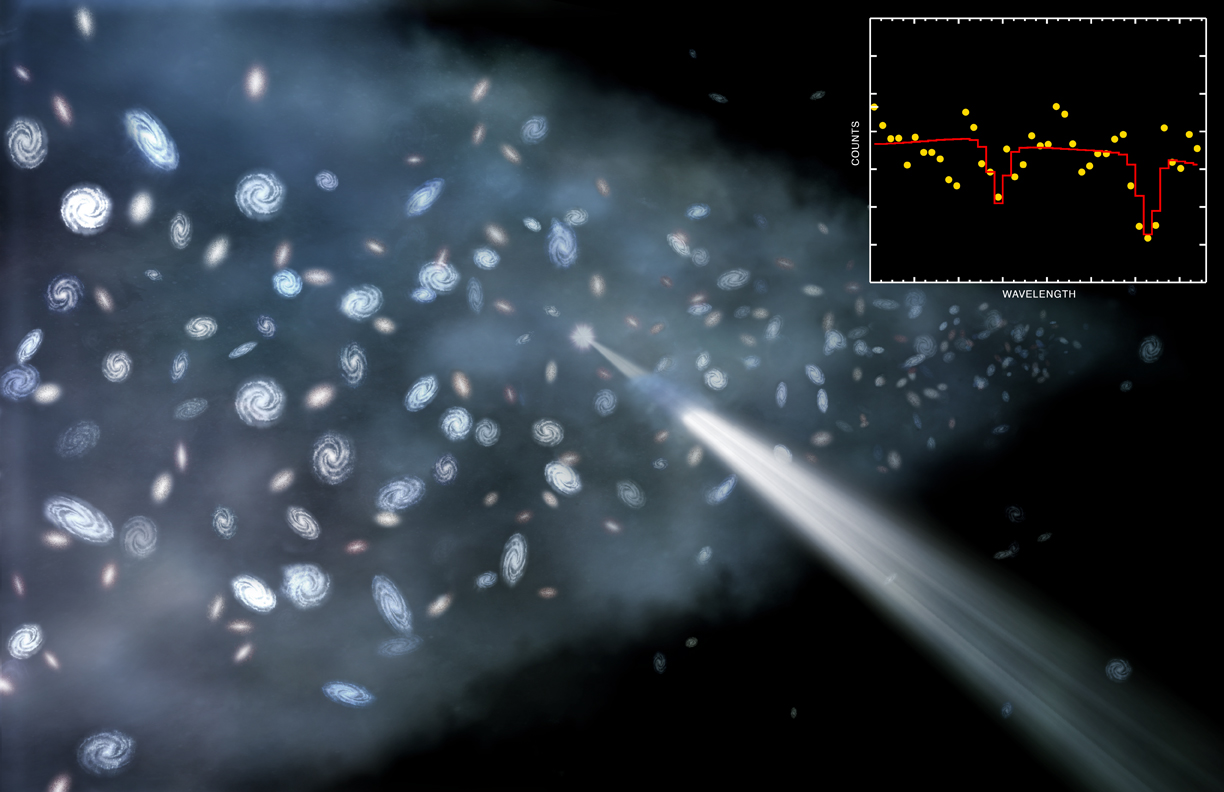
Using observations with NASA's Chandra X-ray Observatory and ESA's XMM-Newton, astronomers have announced a robust detection of a vast reservoir of intergalactic gas about 400 million light years from Earth. This discovery is the strongest evidence yet that the "missing matter" in the nearby Universe is located in an enormous web of hot, diffuse gas.
This missing matter — which is different from dark matter -- is composed of baryons, the particles, such as protons and neutrons, that are found on the Earth, in stars, gas, galaxies, and so on. A variety of measurements of distant gas clouds and galaxies have provided a good estimate of the amount of this "normal matter" present when the universe was only a few billion years old. However, an inventory of the much older, nearby universe has turned up only about half as much normal matter, an embarrassingly large shortfall.
The mystery then is where does this missing matter reside in the nearby Universe? This latest work supports predictions that it is mostly found in a web of hot, diffuse gas known as the Warm-Hot Intergalactic Medium (WHIM). Scientists think the WHIM is material left over after the formation of galaxies, which was later enriched by elements blown out of galaxies.
"Evidence for the WHIM is really difficult to find because this stuff is so diffuse and easy to see right through," said Taotao Fang of the University of California at Irvine and lead author of the latest study. "This differs from many areas of astronomy where we struggle to see through obscuring material."
To look for the WHIM, the researchers examined X-ray observations of a rapidly growing supermassive black hole known as an active galactic nucleus, or AGN. This AGN, which is about two billion light years away, generates immense amounts of X-ray light as it pulls matter inwards.
Lying along the line of sight to this AGN, at a distance of about 400 million light years, is the so-called Sculptor Wall. This "wall", which is a large diffuse structure stretching across tens of millions of light years, contains thousands of galaxies and potentially a significant reservoir of the WHIM if the theoretical simulations are correct. The WHIM in the wall should absorb some of the X-rays from the AGN as they make their journey across intergalactic space to Earth.
Using new data from Chandra and previous observations with both Chandra and XMM-Newton, absorption of X-rays by oxygen atoms in the WHIM has clearly been detected by Fang and his colleagues. The characteristics of the absorption are consistent with the distance of the Sculptor Wall as well as the predicted temperature and density of the WHIM. This result gives scientists confidence that the WHIM will also be found in other large-scale structures.
Several previous claimed detections of the hot component of the WHIM have been controversial because the detections had been made with only one X-ray telescope and the statistical significance of many of the results had been questioned.
"Having good detections of the WHIM with two different telescopes is really a big deal," said co-author David Buote, also from the University of California at Irvine. "This gives us a lot of confidence that we have truly found this missing matter."
In addition to having corroborating data from both Chandra and XMM-Newton, the new study also removes another uncertainty from previous claims. Because the distance of the Sculptor Wall is already known, the statistical significance of the absorption detection is greatly enhanced over previous "blind" searches. These earlier searches attempted to find the WHIM by observing bright AGN at random directions on the sky, in the hope that their line of sight intersects a previously undiscovered large-scale structure.
Confirmed detections of the WHIM have been made difficult because of its extremely low density. Using observations and simulations, scientists calculate the WHIM has a density equivalent to only 6 protons per cubic meter. For comparison, the interstellar medium -- the very diffuse gas in between stars in our galaxy -- typically has about a million hydrogen atoms per cubic meter.
People Who Read This Also Read...
.leftside_bg_Also_visited {
background-image:url(/graphics/ws/podcasts_bg_also_visited.jpg);
background-repeat:repeat-x;
height:36px;
font-size:15px;
font-family:"Bank Gothic";
/*font-variant:small-caps;*/
font-weight:500;
text-align:left;
padding-left:5px;
color:#333333;
}
}
People Who Read This Also Read…-->
Carbon Atmosphere Discovered On Neutron Star
NASA's Great Observatories Celebrate International Year of Astronomy
NASA Celebrates Chandra's 10th Anniversary
Massey Award Given to Harvey Tananbaum
"Evidence for the WHIM has even been much harder to find than evidence for dark matter, which is invisible but can be detected because of its gravitational effects on stars and galaxies," said Fang.
There have been important detections of possible WHIM in the nearby Universe with relatively low temperatures of about 100,000 degrees using ultraviolet observations and relatively high temperature WHIM of about 10 million degrees using observations of X-ray emission in galaxy clusters. However, these are expected to account for only a relatively small fraction of the WHIM. The X-ray absorption studies reported here probe temperatures of about a million degrees where most of the WHIM is predicted to be found.
These results appear in the May 10th issue of The Astrophysical Journal. NASA's Marshall Space Flight Center in Huntsville, Ala., manages the Chandra program for NASA's Science Mission Directorate in Washington. The Smithsonian Astrophysical Observatory controls Chandra's science and flight operations from Cambridge, Mass.
More information, including images and other multimedia, can be found at:http://chandra.harvard.edu/ and http://chandra.nasa.gov/
Kaydol:
Yorumlar (Atom)

