Chandra Images by Date: 2009
17 Dec 09
G292.0+1.8
Supernova remnants representing two different types of supernova explosions.
17 Dec 09
Kepler's Supernova Remnant
Supernova remnants representing two different types of supernova explosions.
10 Dec 09
NGC 6872
A pair of colliding galaxies at a distance of about 180 million light years from Earth.
23 Nov 09
Crab Nebula
The remnants of a star that exploded and that appeared in Earth's sky almost a thousand years ago.
10 Nov 09
Galactic Center
The core of the Milky Way at a distance of some 26,000 light years from Earth.
04 Nov 09
Cassiopeia A
A supernova remnant in the Milky Way with a neutron star at its center.
22 Oct 09
JKCS041
A galaxy cluster located about 10.2 billion light years from Earth.
06 Oct 09
NGC 6240
A galaxy about 330 million light years from Earth.
22 Sep 09
Galactic Center
A 400 by 900 light-year mosaic of images located about 26,000 light years from Earth.
14 Sep 09
Hydra A
A galaxy cluster about 840 million light years from Earth.
27 Aug 09
Cygnus X-1
A black hole in close orbit around a blue supergiant star.
12 Aug 09
Cepheus B
A cloud of molecular hydrogen in the Milky Way about 2,400 light years from Earth.
23 Jul 09
E0102-72.3
Officially known as 1E0102.2-7129, a supernova remnant in the Small Magellanic Cloud.
09 Jul 09
Stephan's Quintet
A group of galaxies that is located about 280 million light years from Earth.
26 Jun 09
RCW 86
A supernova remnant in the Milky Way, about 8,200 light years from Earth.
24 Jun 09
Lyman Alpha Blobs
Giant reservoirs of hydrogen gas about 10 billion light years away.
09 Jun 09
SNR 0104-72.3
A supernova remnant located in the Small Magellanic Cloud, about 190,000 light years from Earth.
28 May 09
HDF 130
A supermassive black hole in a distant galaxy, about 10 billion light years away.
14 May 09
3C305
A galaxy, about 600 million light years away, with a supermassive black hole at its center.
29 Apr 09
Galactic X-ray Ridge
A ridge-like structure near the center of the Milky Way of X-ray emission discovered by earlier telescopes.
16 Apr 09
MACSJ0717.5+3745
One of the most complex galaxy clusters, located about 5.4 billion light years from Earth.
03 Apr 09
PSR B1509-58
(B1509)
A 1700-year-old pulsar and its nebula, located about 17,000 light years from Earth.
25 Mar 09
GRS 1915+105
A stellar-mass black hole with about 14 times the Sun’s mass in the Milky Way.
11 Mar 09
NGC 4194
A galaxy lies about 110 million light years away
26 Feb 09
PSR J0108-1431
The oldest pulsar detected in X-rays at a distance of about 770 light years from Earth.
18 Feb 09
Tycho's Supernova Remnant
The hot, expanding debris of a supernova observed in 1572.
10 Feb 09
M101
A face-on spiral galaxy about 22 million light years from Earth.
30 Jan 09
Centaurus A
An active galaxy at a distance of 10 million light years from Earth.
27 Jan 09
NGC 604
The largest region of star formation in the nearby galaxy M33
06 Jan 09
Cassiopeia A
The supernova remnant that was Chandra's "First Light" has been observed over time.
06 Jan 09
Cassiopeia A
A multiwavelength three-dimensional (3-D) reconstruction of a supernova remnant has been created.
18 Aralık 2009 Cuma


8 Aralık 2009 Salı
Major Milestones In X-ray Astronomy
Major Milestones In X-ray Astronomyby WKT June 6, 2002 :: In September, 1949, a team led by Herbert Friedman of the Naval Research Laboratory detected weak X-ray emission from the solar corona, the hot outer layers of the Sun's atmosphere. Their experiment consisted of a collection of small Geiger counters aboard a captured German V-2 rocket. It took more than a decade before a greatly improved detector discovered X-rays coming from sources beyond the solar system. In 1962, a team of scientists under the direction of Riccardo Giacconi at American Science and Engineering in Cambridge, MA., used a small X-ray detector aboard an Aerobee rocket to discover Scorpius X-1, the first source of X-rays outside our solar system. Forty years later, over 100,000 X-ray sources have been detected, the most distant of which is 13 billion light years from Earth. This extraordinary leap in sensitivity has been due, in large part, to the development of telescopes that can focus X-rays.
Flash Versionof Timeline The first imaging X-ray telescope was made by Giacconi and collaborators. It was flown on a small sounding rocket in October 1963 and made crude images of hot spots in the upper atmosphere of the sun. This telescope was about the same diameter and length as the optical telescope Galileo used in 1610. Over a period of 380 years, optical telescopes improved in sensitivity by 100 million times from Galileo's telescope to the Hubble Space Telescope. Remarkably, the Chandra X-ray Observatory represents a comparable leap in sensitivity over Giacconi's 1963 telescope, yet it took only 36 years!
Flash Versionof Timeline The first imaging X-ray telescope was made by Giacconi and collaborators. It was flown on a small sounding rocket in October 1963 and made crude images of hot spots in the upper atmosphere of the sun. This telescope was about the same diameter and length as the optical telescope Galileo used in 1610. Over a period of 380 years, optical telescopes improved in sensitivity by 100 million times from Galileo's telescope to the Hubble Space Telescope. Remarkably, the Chandra X-ray Observatory represents a comparable leap in sensitivity over Giacconi's 1963 telescope, yet it took only 36 years!
Nasa tests Aberdeenshire find for life on Mars clues
Nasa tests Aberdeenshire find for life on Mars clues
Advertisement
Nasa scientists test Macaulayite in an Aberdeenshire quarry for Mars clue
Scientists from space agency Nasa are testing a mineral only found in one corner of Scotland to see if it can provide clues about life on Mars.
Macaulayite is only believed to exist at a quarry at the foot of Bennachie in Aberdeenshire.
Researchers think it could be the same mineral which gives the planet its red colour.
Samples have now been sent to a testing centre in California in an attempt to verify its presence.
Macaulayite was discovered by researchers from Aberdeen's Macaulay Institute in the late 1970s.
Tests are being carried out on Macaulayite found in Aberdeenshire
The mineral is formed in the presence of water so if it does occur on the surface of Mars it could provide proof the planet can sustain life.
It is formed from granite which has been weathered by tropical climates from before the last Ice Age.
The team which found it was led by mineralogist Jeff Wilson, who is now retired.
Dr Wilson told BBC Scotland: "It is exciting because this particular mineral contains water.
"It's a very fine grain mineral and water is bound to the inner surfaces.
"There's been a lot of speculation about the occurrence of water on Mars. We don't know but it could be associated with this mineral."
The US space agency Nasa is conducting tests on Macaulayite.
Dr Janice Bishop, a Mars specialist from the Search for Extra Terrestrial Intelligence Institute, said: "All life forms as we know it require liquid water so if we can actually find periods of time or places on the planet where there was standing water then the chance of life having formed increase greatly."
Only limited data has been collected about the surface of Mars, through orbiters and probe landings.
Advertisement
Nasa scientists test Macaulayite in an Aberdeenshire quarry for Mars clue
Scientists from space agency Nasa are testing a mineral only found in one corner of Scotland to see if it can provide clues about life on Mars.
Macaulayite is only believed to exist at a quarry at the foot of Bennachie in Aberdeenshire.
Researchers think it could be the same mineral which gives the planet its red colour.
Samples have now been sent to a testing centre in California in an attempt to verify its presence.
Macaulayite was discovered by researchers from Aberdeen's Macaulay Institute in the late 1970s.
Tests are being carried out on Macaulayite found in Aberdeenshire
The mineral is formed in the presence of water so if it does occur on the surface of Mars it could provide proof the planet can sustain life.
It is formed from granite which has been weathered by tropical climates from before the last Ice Age.
The team which found it was led by mineralogist Jeff Wilson, who is now retired.
Dr Wilson told BBC Scotland: "It is exciting because this particular mineral contains water.
"It's a very fine grain mineral and water is bound to the inner surfaces.
"There's been a lot of speculation about the occurrence of water on Mars. We don't know but it could be associated with this mineral."
The US space agency Nasa is conducting tests on Macaulayite.
Dr Janice Bishop, a Mars specialist from the Search for Extra Terrestrial Intelligence Institute, said: "All life forms as we know it require liquid water so if we can actually find periods of time or places on the planet where there was standing water then the chance of life having formed increase greatly."
Only limited data has been collected about the surface of Mars, through orbiters and probe landings.
Cool find in hunt for exoplanets
Cool find in hunt for exoplanets
By Jason Palmer Science and technology reporter, BBC News
The planet, called GJ758B, may well have a sister, GJ758C
Astronomers have published an image of the coolest planet outside our solar system that has been pictured directly.
The new find is more similar to our own Solar System than prior pictured exoplanets, in terms of the parent star's type and the planet's size.
However, the surface temperature is a scorching 280-370C, and could still prove to be a brown dwarf star.
The results, published in Astrophysical Journal, were obtained by a new camera on the Subaru telescope in Hawaii.
Among more than 400 known exoplanets, only 10 have been imaged directly, rather than detecting them via measurements of their parent stars' light or movement.
The task is notoriously difficult, akin to discerning a match next to a floodlight at a distance of kilometres.
One good turn
The new HiCIAO camera makes it possible to spot exoplanets next to their parent stars through a process called angular differential imaging.
In this approach, successive pictures are taken when a target star is directly overhead in the sky and possible exoplanets appear to rotate around it; any specks of light due to the measurement stay put and can be subtracted.
In two observations in May and August, an international team of researchers led by the Max Planck Institute for Astronomy focused the telescope on GJ758, a star about 50 light-years away.
They found a so-called gas giant planet of a mass somewhere between 10 and 40 times that of Jupiter, in an oval-shaped orbit around the star.
Exoplanets are tough to picture directly, but methods are being refined
It is presently at a distance about the same as between our Sun and Neptune. Because of the elliptical orbit, its average distance from its host star is about one-and-a-half times that between our Sun and Pluto.
Because it remains so hot despite the considerable distance from its star, the researchers believe it is still in the process of contracting.
As is the case with many potential exoplanets of that estimated mass, GJ758B may be a brown dwarf star.
"We can see how warm this thing is but we don't know for how long it has cooled, because we don't know the age of the system - that's the tricky part," said Markus Janson, one of the authors on the paper now at the University of Toronto.
Knowing the age as well as the temperature of GJ758B will help determine exactly how massive it is, and thereby if it is in fact a planet or a brown dwarf.
"One thing we want to do is to examine the star, because determining the properties of the star is the easiest way to determine the age of the star," he told BBC News.
However, the August observation turned up another interesting possibility.
"We also want to follow up on another candidate in the system that can be seen in the images, but we have to see if it's actually bound to the star, or whether it's something that's just there by chance."
The team will continue its measurements on the parent star and investigate the second candidate - GJ758C - in the spring of 2010.
By Jason Palmer Science and technology reporter, BBC News
The planet, called GJ758B, may well have a sister, GJ758C
Astronomers have published an image of the coolest planet outside our solar system that has been pictured directly.
The new find is more similar to our own Solar System than prior pictured exoplanets, in terms of the parent star's type and the planet's size.
However, the surface temperature is a scorching 280-370C, and could still prove to be a brown dwarf star.
The results, published in Astrophysical Journal, were obtained by a new camera on the Subaru telescope in Hawaii.
Among more than 400 known exoplanets, only 10 have been imaged directly, rather than detecting them via measurements of their parent stars' light or movement.
The task is notoriously difficult, akin to discerning a match next to a floodlight at a distance of kilometres.
One good turn
The new HiCIAO camera makes it possible to spot exoplanets next to their parent stars through a process called angular differential imaging.
In this approach, successive pictures are taken when a target star is directly overhead in the sky and possible exoplanets appear to rotate around it; any specks of light due to the measurement stay put and can be subtracted.
In two observations in May and August, an international team of researchers led by the Max Planck Institute for Astronomy focused the telescope on GJ758, a star about 50 light-years away.
They found a so-called gas giant planet of a mass somewhere between 10 and 40 times that of Jupiter, in an oval-shaped orbit around the star.
Exoplanets are tough to picture directly, but methods are being refined
It is presently at a distance about the same as between our Sun and Neptune. Because of the elliptical orbit, its average distance from its host star is about one-and-a-half times that between our Sun and Pluto.
Because it remains so hot despite the considerable distance from its star, the researchers believe it is still in the process of contracting.
As is the case with many potential exoplanets of that estimated mass, GJ758B may be a brown dwarf star.
"We can see how warm this thing is but we don't know for how long it has cooled, because we don't know the age of the system - that's the tricky part," said Markus Janson, one of the authors on the paper now at the University of Toronto.
Knowing the age as well as the temperature of GJ758B will help determine exactly how massive it is, and thereby if it is in fact a planet or a brown dwarf.
"One thing we want to do is to examine the star, because determining the properties of the star is the easiest way to determine the age of the star," he told BBC News.
However, the August observation turned up another interesting possibility.
"We also want to follow up on another candidate in the system that can be seen in the images, but we have to see if it's actually bound to the star, or whether it's something that's just there by chance."
The team will continue its measurements on the parent star and investigate the second candidate - GJ758C - in the spring of 2010.
18 Temmuz 2009 Cumartesi
The discovery of sharp resonance states in exotic, proton emitting, nuclei.
The discovery of sharp resonance states in exotic, proton emitting, nuclei.Little is known about the structure of unstable, proton emitting, nuclei.These nuclei can be produced during stellar explosions in the cosmos, andlive only for a very small fraction of second before they disintegrateinto more stable products. Nowadays, they are also produced and detectedin experiments made in large modern nuclear physics laboratories that areequipped with radioactive ion beams. Such elusive nuclei rapidly decay byemitting one (and sometimes two) protons, and for this reason areindicated as nuclei that lie outside of the so-called proton drip line.A recent publication (1) reports results of an experiment at the GSIlaboratory in Darmstdtat, Germany that showed the existence of excitedunstable states in two such nuclei, Fluorine-15 and Neon-16. Contrary tothe ground level characterized by a broad resonance with short life, theseexcited states have half-lives sufficiently long that they can beidentified as sharp resonances. Of note is that they have excitationenergy of several MeV, establishing that such particle unstable systemscan have an observable set of levels just as do the many known, particlestable nuclei.The existence of such narrow resonances in particle unstable nuclei, andin Fluorine-15 in particular, was predicted (2) three years ago by amethod of calculation put forward by nuclear theoreticians of the INFN,sez. di Padova, in collaboration with colleagues from Australia, Canadaand South Africa. To implement the method (an algebraic solution ofsystems of coupled equations for the problem of nuclear scattering andreactions) expertise in high performance computing was employed. Theexistence of sharp resonances in the spectra of radioactive, andspecifically of proton (and, may-be, of neutron) emitting nuclei, opensnew and interesting perspectives on the way the nuclei, that we observe atpresent in our Universe, have been formed.(1) Physical Review C (Rapid Communication) 79, 061301 (2009).(2) Physical Review Letters, 96, 072502 (2006).
17 Temmuz 2009 Cuma
Supernova may be in a new class
Supernova may be in a new class
Oddball stellar explosion doesn’t match known outbursts
By Ron Cowen
July 18th, 2009; Vol.176 #2 (p. 9)
Text Size
Just in time for July 4, astronomers say they have found a new type of stellar firecracker.
Stars that die an explosive death generally fall into two categories: young, massive stars that collapse under their own weight and hurl their outer layers into space, and older, sunlike stars that undergo a thermonuclear explosion. But the stellar explosion recorded in January 2005 and known as SN 2005E doesn’t fit either class, according to a new analysis reported online June 11 at arXiv.org.
The explosion ejected only a small amount of material — the equivalent of 0.3 solar masses — and erupted in the halo of an isolated galaxy, a region devoid of any star formation. These findings suggest that the explosion, or supernova, did not arise from the collapse of a massive star, report study coauthors Hagai-Binyamin Perets and Avishay Gal-Yam of the Weizmann Institute of Science in Rehovot, Israel, and their colleagues. A massive star would have cast off much more material and would have erupted in a star-forming region. Since stellar heavyweights are so short-lived, they can’t move far from their birth site.
On the other hand, the researchers note, the explosion’s dimness and the abundance of elements forged in the eruption indicate it was not a typical thermonuclear explosion. Spectra show that the debris from the outburst contains five to 10 times more calcium than observed in any other known stellar explosion and probably contains a high abundance of radioactive titanium-44.
“In my experience, there’s lots of strange supernovas out there … but it really does look like this one might be something different,” comments theorist Andrew MacFadyen of New York University.
The authors of the paper declined to be interviewed because they had submitted the report to Nature. In their article, they report that the erupting oddball matches a model in which a compact star called a white dwarf nabs a thick layer of helium from a companion star. The star would then undergo a thermonuclear explosion that would destroy the helium but leave the rest of the white dwarf intact. By contrast, in a common type of supernova known as a type 1a supernova, a white dwarf made up mostly of carbon and oxygen blows itself to smithereens after stealing matter from a companion.
Perets, Gal-Yam and their collaborators report that SN 2005E resembles a few other peculiar supernova, notably an explosion found last year and known as SN 2008ha.
“Both of these objects have very low luminosity, low velocity [of debris] and strong calcium lines,” says Rober Kirshner of the Harvard-Smithsonian Center for Astrophysics in Cambridge, Mass. Kirshner, along with some of the collaborators on the SN 2005e study, is a coauthor of a study on SN 2008ha set to appear in an upcoming issue of The Astronomical Journal.
The conclusions of both papers suggest a weak thermonuclear explosion, although the study of SN 2005E is more far-reaching, Kirshner says. “My guess is that the same interpretation would probably work for both,” he says.
Because both SN 2005E and SN 2008ha are so faint, telescopes may have failed to detect other similar explosions, comments MacFadyen. Supernovas are known to seed galaxies with an assortment of heavy elements. If the number of explosions in the new class is large enough, they may be an important contributor to this process. It’s a well-known story how supernovas produce these elements, “but there’s always room for adding new players to the team,” says MacFadyen
Oddball stellar explosion doesn’t match known outbursts
By Ron Cowen
July 18th, 2009; Vol.176 #2 (p. 9)
Text Size
Just in time for July 4, astronomers say they have found a new type of stellar firecracker.
Stars that die an explosive death generally fall into two categories: young, massive stars that collapse under their own weight and hurl their outer layers into space, and older, sunlike stars that undergo a thermonuclear explosion. But the stellar explosion recorded in January 2005 and known as SN 2005E doesn’t fit either class, according to a new analysis reported online June 11 at arXiv.org.
The explosion ejected only a small amount of material — the equivalent of 0.3 solar masses — and erupted in the halo of an isolated galaxy, a region devoid of any star formation. These findings suggest that the explosion, or supernova, did not arise from the collapse of a massive star, report study coauthors Hagai-Binyamin Perets and Avishay Gal-Yam of the Weizmann Institute of Science in Rehovot, Israel, and their colleagues. A massive star would have cast off much more material and would have erupted in a star-forming region. Since stellar heavyweights are so short-lived, they can’t move far from their birth site.
On the other hand, the researchers note, the explosion’s dimness and the abundance of elements forged in the eruption indicate it was not a typical thermonuclear explosion. Spectra show that the debris from the outburst contains five to 10 times more calcium than observed in any other known stellar explosion and probably contains a high abundance of radioactive titanium-44.
“In my experience, there’s lots of strange supernovas out there … but it really does look like this one might be something different,” comments theorist Andrew MacFadyen of New York University.
The authors of the paper declined to be interviewed because they had submitted the report to Nature. In their article, they report that the erupting oddball matches a model in which a compact star called a white dwarf nabs a thick layer of helium from a companion star. The star would then undergo a thermonuclear explosion that would destroy the helium but leave the rest of the white dwarf intact. By contrast, in a common type of supernova known as a type 1a supernova, a white dwarf made up mostly of carbon and oxygen blows itself to smithereens after stealing matter from a companion.
Perets, Gal-Yam and their collaborators report that SN 2005E resembles a few other peculiar supernova, notably an explosion found last year and known as SN 2008ha.
“Both of these objects have very low luminosity, low velocity [of debris] and strong calcium lines,” says Rober Kirshner of the Harvard-Smithsonian Center for Astrophysics in Cambridge, Mass. Kirshner, along with some of the collaborators on the SN 2005e study, is a coauthor of a study on SN 2008ha set to appear in an upcoming issue of The Astronomical Journal.
The conclusions of both papers suggest a weak thermonuclear explosion, although the study of SN 2005E is more far-reaching, Kirshner says. “My guess is that the same interpretation would probably work for both,” he says.
Because both SN 2005E and SN 2008ha are so faint, telescopes may have failed to detect other similar explosions, comments MacFadyen. Supernovas are known to seed galaxies with an assortment of heavy elements. If the number of explosions in the new class is large enough, they may be an important contributor to this process. It’s a well-known story how supernovas produce these elements, “but there’s always room for adding new players to the team,” says MacFadyen
Pairing off in the early universe
Pairing off in the early universe
Simulations reveal that some of the first stars had partners
By Ron Cowen
August 1st, 2009; Vol.176 #3 (p. 7)
Text Size
EnlargeStellar companionA simulation of a star-forming region about 200 million years after the Big Bang shows two embryonic stars (yellow), each about five times the mass of the sun and separated by 800 times the Earth-sun distance. The computer model indicates that the two embryos will draw closer and form a binary star system, with each member as massive as 100 suns.Copyright Science/AAAS
It’s usually nice to have a companion. And in the lonely, dark expanse of the early universe, even some of the first stars had soul mates, new simulations reveal.
Previous studies had indicated that the first stars were extraordinarily massive — at least 100 times as heavy as the sun — but were also loners (SN: 6/8/2002, p. 362). Now, more detailed modeling, including a careful consideration of how atomic and molecular hydrogen interact at low densities, reveals that at least 5 percent and perhaps as many as half of these heavyweights were gravitationally bound to similar-mass companions, says Tom Abel of Stanford University He and his colleagues, Matthew Turk of Stanford and Brian O’Shea of Michigan State University in East Lansing, report their findings online July 9 in Science.
Pairs of massive stars are intriguing, notes Abel, because each star will probably collapse into a black hole. The coalescence of the two black holes would be a key source of gravitational waves, ripples in space-time predicted by Einstein’s theory of general relativity but never directly detected.
A second star’s presence could also enhance the production of distant gamma-ray bursts, flashes of high-energy light that have long-lasting afterglows and provide a window on the early universe. Gamma-ray bursts are produced when a single, massive star that crunches down into a black hole generates powerful jets of particles. A companion star can spin up its partner, and such rapid rotation may help generate the energetic jets, Abel says.
Star formation in the early universe is relatively easy to model because the infant cosmos contained only a few elements — mainly hydrogen and helium gas — which cooled and collapsed to produce stars. But even the simple interactions between atomic and molecular hydrogen hadn‘t been previously studied at low-enough densities, Abel says. He and his colleagues followed the star-forming process about 200 million years after the Big Bang, as gravity condensed gas clouds, to much higher densities than his team could in past simulations, Abel adds.
Only one in five of the team’s simulations produced stellar pairs, and for now the researchers can only provide a rough estimate of the percentage of first stars that would have had partners. He expects that within a year, larger, more comprehensive simulations will pin down the number.
The first generation of stars is not visible with today’s telescopes, but the proposed successor to Hubble, the infrared James Webb Space Telescope, scheduled for launch in 2014, has a good chance of recording large groupings of these earliest of glimmers.
“The simulations make good sense,” says theorist Volker Bromm of the University of Texas at Austin. Bromm says that his own team’s simulations track the evolution of pairs or groups of embryonic stars for an additional 100,000 years beyond that of Turk’s group — a necessity, he says, to determine if the baby stars merge into one big star or remain separate. His team indeed finds that the fledgling stars remain close partners. Bromm says his team plans to post a paper online describing the results later this month.
Simulations reveal that some of the first stars had partners
By Ron Cowen
August 1st, 2009; Vol.176 #3 (p. 7)
Text Size
EnlargeStellar companionA simulation of a star-forming region about 200 million years after the Big Bang shows two embryonic stars (yellow), each about five times the mass of the sun and separated by 800 times the Earth-sun distance. The computer model indicates that the two embryos will draw closer and form a binary star system, with each member as massive as 100 suns.Copyright Science/AAAS
It’s usually nice to have a companion. And in the lonely, dark expanse of the early universe, even some of the first stars had soul mates, new simulations reveal.
Previous studies had indicated that the first stars were extraordinarily massive — at least 100 times as heavy as the sun — but were also loners (SN: 6/8/2002, p. 362). Now, more detailed modeling, including a careful consideration of how atomic and molecular hydrogen interact at low densities, reveals that at least 5 percent and perhaps as many as half of these heavyweights were gravitationally bound to similar-mass companions, says Tom Abel of Stanford University He and his colleagues, Matthew Turk of Stanford and Brian O’Shea of Michigan State University in East Lansing, report their findings online July 9 in Science.
Pairs of massive stars are intriguing, notes Abel, because each star will probably collapse into a black hole. The coalescence of the two black holes would be a key source of gravitational waves, ripples in space-time predicted by Einstein’s theory of general relativity but never directly detected.
A second star’s presence could also enhance the production of distant gamma-ray bursts, flashes of high-energy light that have long-lasting afterglows and provide a window on the early universe. Gamma-ray bursts are produced when a single, massive star that crunches down into a black hole generates powerful jets of particles. A companion star can spin up its partner, and such rapid rotation may help generate the energetic jets, Abel says.
Star formation in the early universe is relatively easy to model because the infant cosmos contained only a few elements — mainly hydrogen and helium gas — which cooled and collapsed to produce stars. But even the simple interactions between atomic and molecular hydrogen hadn‘t been previously studied at low-enough densities, Abel says. He and his colleagues followed the star-forming process about 200 million years after the Big Bang, as gravity condensed gas clouds, to much higher densities than his team could in past simulations, Abel adds.
Only one in five of the team’s simulations produced stellar pairs, and for now the researchers can only provide a rough estimate of the percentage of first stars that would have had partners. He expects that within a year, larger, more comprehensive simulations will pin down the number.
The first generation of stars is not visible with today’s telescopes, but the proposed successor to Hubble, the infrared James Webb Space Telescope, scheduled for launch in 2014, has a good chance of recording large groupings of these earliest of glimmers.
“The simulations make good sense,” says theorist Volker Bromm of the University of Texas at Austin. Bromm says that his own team’s simulations track the evolution of pairs or groups of embryonic stars for an additional 100,000 years beyond that of Turk’s group — a necessity, he says, to determine if the baby stars merge into one big star or remain separate. His team indeed finds that the fledgling stars remain close partners. Bromm says his team plans to post a paper online describing the results later this month.
15 Temmuz 2009 Çarşamba
Fermilab's CDF observes Omega-sub-b baryon
Fermilab's CDF observes Omega-sub-b baryonAt a recent physics seminar at the Department of Energy's Fermi NationalAccelerator Laboratory, Fermilab physicist Pat Lukens of the CDFexperiment announced the observation of a new particle, the Omega-sub-b.The particle contains three quarks: two strange quarks and a bottom quark(s-s-b). It is an exotic relative of the much more common proton and hasabout six times the proton's mass.The observation of this "doubly strange" particle, predicted by theStandard Model, is significant because it strengthens physicists'confidence in their understanding of how quarks form matter. In addition,it conflicts with a 2008 result announced by CDF's sister experiment,DZero.The Omega-sub-b is the latest entry in the "periodic table of baryons."Baryons are particles formed of three quarks, the most common examplesbeing the proton and neutron. The Tevatron particle accelerator atFermilab is unique in its ability to produce baryons containing the bquark, and the large data samples now available after many years ofsuccessful running enable experimenters to find and study these rareparticles. The observation opens a new window for scientists toinvestigate its properties and better understand this rare object.Combing through almost half a quadrillion (1000 billion) proton-antiprotoncollisions produced by Fermilab's Tevatron particle collider, the CDFcollaboration isolated 16 examples in which the particles emerging from acollision revealed the distinctive signature of the Omega-sub-b. Onceproduced, the Omega-sub-b travels a fraction of a millimeter before itdecays into lighter particles. This decay, mediated by the weak force,occurs in about a trillionth of a second. In fact, CDF has performed thefirst ever measurement of the Omega-sub-b lifetime and obtained 1.13+0.53-0.40(stat.) ± 0.02(syst.) trillionths of a second.In August 2008, the DZero experiment announced its own observation of theOmega-sub-b based on a smaller sample of Tevatron data. Interestingly,the new CDF observation announced here is in direct conflict with theearlier DZero result. The CDF physicists measured the Omega-sub-b mass tobe 6054.4 ± 6.8(stat.) ± 0.9(syst.) MeV/c^2, compared to DZero's 6165 ±10(stat.) ± 13(syst.) MeV/c^2. These two experimental results arestatistically inconsistent with each other, leaving scientists from bothexperiments wondering whether they are measuring the same particle.Furthermore, the experiments observed different rates of production ofthis particle. Perhaps most interesting is that neither experiment sees ahint of evidence for the particle at the other's measured value.Although the latest result announced by CDF agrees with theoreticalexpectation for the Omega-sub-b both in the measured production rate andin the mass value, further investigation is needed to solve the puzzle ofthese conflicting results.The Omega-sub-b discovery follows the observation of the Cascade-b-minusbaryon, first observed at the Tevatron in 2007, and two types ofSigma-sub-b baryons, discovered at the Tevatron in 2006.The CDF collaboration submitted a paper that summarizes the details of itsdiscovery to the journal Physical Review D. It is available online at:http://arxiv.org/abs/0905.3123CDF is an international experiment of about 600 physicists from 62institutions in 15 countries. It is supported by the U.S. Department ofenergy, the National Science Foundation and a number of internationalfunding agencies. Fermilab is a national laboratory funded by the Officeof Science of the U.S. Department of Energy, operated under contract byFermi Research Alliance, LLC.
a galaxy collision in action
A compact group of galaxies, discovered about 130 years ago, about 280 million light years from Earth.
One galaxy is passing through a core of four other galaxies.
A shock wave generated from this motion heats the gas and produces X-rays detected by Chandra.
This beautiful image gives a new look at Stephan's Quintet, a compact group of galaxies discovered about 130 years ago and located about 280 million light years from Earth. The curved, light blue ridge running down the center of the image shows X-ray data from the Chandra X-ray Observatory. Four of the galaxies in the group are visible in the optical image (yellow, red, white and blue) from the Canada-France-Hawaii Telescope. A labeled version (roll over the image above) identifies these galaxies (NGC 7317, NGC 7318a, NGC 7318b and NGC 7319) as well as a prominent foreground galaxy (NGC 7320) that is not a member of the group. The galaxy NGC 7318b is passing through the core of galaxies at almost 2 million miles per hour, and is thought to be causing the ridge of X-ray emission by generating a shock wave that heats the gas.
Additional heating by supernova explosions and stellar winds has also probably taken place in Stephan's Quintet. A larger halo of X-ray emission - not shown here - detected by ESA's XMM-Newton could be evidence of shock-heating by previous collisions between galaxies in this group. Some of the X-ray emission is likely also caused by binary systems containing massive stars that are losing material to neutron stars or black holes.
Stephan's Quintet provides a rare opportunity to observe a galaxy group in the process of evolving from an X-ray faint system dominated by spiral galaxies to a more developed system dominated by elliptical galaxies and bright X-ray emission. Being able to witness the dramatic effect of collisions in causing this evolution is important for increasing our understanding of the origins of the hot, X-ray bright halos of gas in groups of galaxies.
Stephan's Quintet shows an additional sign of complex interactions in the past, notably the long tails visible in the optical image. These features were probably caused by one or more passages through the galaxy group by NGC 7317.
One galaxy is passing through a core of four other galaxies.
A shock wave generated from this motion heats the gas and produces X-rays detected by Chandra.
This beautiful image gives a new look at Stephan's Quintet, a compact group of galaxies discovered about 130 years ago and located about 280 million light years from Earth. The curved, light blue ridge running down the center of the image shows X-ray data from the Chandra X-ray Observatory. Four of the galaxies in the group are visible in the optical image (yellow, red, white and blue) from the Canada-France-Hawaii Telescope. A labeled version (roll over the image above) identifies these galaxies (NGC 7317, NGC 7318a, NGC 7318b and NGC 7319) as well as a prominent foreground galaxy (NGC 7320) that is not a member of the group. The galaxy NGC 7318b is passing through the core of galaxies at almost 2 million miles per hour, and is thought to be causing the ridge of X-ray emission by generating a shock wave that heats the gas.
Additional heating by supernova explosions and stellar winds has also probably taken place in Stephan's Quintet. A larger halo of X-ray emission - not shown here - detected by ESA's XMM-Newton could be evidence of shock-heating by previous collisions between galaxies in this group. Some of the X-ray emission is likely also caused by binary systems containing massive stars that are losing material to neutron stars or black holes.
Stephan's Quintet provides a rare opportunity to observe a galaxy group in the process of evolving from an X-ray faint system dominated by spiral galaxies to a more developed system dominated by elliptical galaxies and bright X-ray emission. Being able to witness the dramatic effect of collisions in causing this evolution is important for increasing our understanding of the origins of the hot, X-ray bright halos of gas in groups of galaxies.
Stephan's Quintet shows an additional sign of complex interactions in the past, notably the long tails visible in the optical image. These features were probably caused by one or more passages through the galaxy group by NGC 7317.
X-Ray Absorbtion
X-Ray Absorption
Absorption by the Earth's atmosphere restricts ground-based observations to radio, near infrared, and visible wavelengths. X-rays are absorbed high above the Earth in the following way:
X-ray photons--tiny high-energy packets of electromagnetic radiation--are absorbed by encounters with individual atoms. Even though the atoms in the atmosphere are widely spaced, the total thickness of the atmosphere is large and the total number of atoms is enormous. An X-ray photon passing through the atmosphere will encounter as many atoms as it would in passing through a 5 meter (16 ft) thick wall of concrete!
What happens when an X-ray is absorbed in the atmosphere?
The energy of the X-ray goes into tearing one of the electrons away from its orbit around the nucleus of a nitrogen or an oxygen atom.
This process is called photo-electric absorption, because a photon is absorbed in the process of removing an electron from an atom. The high-energy of X-rays is necessary for photo-electric absorption to take place.
X-ray telescopes in orbit above the Earth's atmosphere can collect X-rays from energetic sources billions of light years away. These cosmic X-rays are focused by barrel-shaped mirrors onto an instrument especially designed to measure properties such as the incoming direction and energy of the X-ray photon. A gaseous or solid material in the instrument absorbs the X-rays by the photo-electric effect.
Absorption by the Earth's atmosphere restricts ground-based observations to radio, near infrared, and visible wavelengths. X-rays are absorbed high above the Earth in the following way:
X-ray photons--tiny high-energy packets of electromagnetic radiation--are absorbed by encounters with individual atoms. Even though the atoms in the atmosphere are widely spaced, the total thickness of the atmosphere is large and the total number of atoms is enormous. An X-ray photon passing through the atmosphere will encounter as many atoms as it would in passing through a 5 meter (16 ft) thick wall of concrete!
What happens when an X-ray is absorbed in the atmosphere?
The energy of the X-ray goes into tearing one of the electrons away from its orbit around the nucleus of a nitrogen or an oxygen atom.
This process is called photo-electric absorption, because a photon is absorbed in the process of removing an electron from an atom. The high-energy of X-rays is necessary for photo-electric absorption to take place.
X-ray telescopes in orbit above the Earth's atmosphere can collect X-rays from energetic sources billions of light years away. These cosmic X-rays are focused by barrel-shaped mirrors onto an instrument especially designed to measure properties such as the incoming direction and energy of the X-ray photon. A gaseous or solid material in the instrument absorbs the X-rays by the photo-electric effect.
1 Temmuz 2009 Çarşamba
A super efficient particle accelerator-chandra blog-
This image of data from NASA's Chandra X-ray Observatory and the European Southern Observatory's Very Large Telescope shows a part of the roughly circular supernova remnant known as RCW 86. This remnant is the remains of an exploded star, which may have been observed on Earth in 185 AD by Chinese astronomers. By studying this remnant, a team of astronomers was able to understand new details about the role of supernova remnants as the Milky Way's super-efficient particle accelerators. The team shows that the shock wave visible in this area is very efficient at accelerating particles and the energy used in this process matches the number of cosmic rays observed on Earth.
The VLT data (colored red in the composite) was used to measure the temperature of the gas right behind the shock wave created by the stellar explosion. Using X-ray images from Chandra (blue), taken three years apart, the researchers were also able to determine the speed of the shock wave to be between one and three percent of the speed of light. The temperature found by these latest results is much lower than expected, given the measured shock wave's velocity. The researchers conclude that the missing energy goes into accelerating the cosmic rays.
The VLT data (colored red in the composite) was used to measure the temperature of the gas right behind the shock wave created by the stellar explosion. Using X-ray images from Chandra (blue), taken three years apart, the researchers were also able to determine the speed of the shock wave to be between one and three percent of the speed of light. The temperature found by these latest results is much lower than expected, given the measured shock wave's velocity. The researchers conclude that the missing energy goes into accelerating the cosmic rays.
29 Haziran 2009 Pazartesi
Seamless Astronomy and Remote Collaborations | ChandraBlog
Seamless Astronomy and Remote Collaborations
General
Submitted by chandra on Mon, 06/29/2009 - 13:59.
Pepi Fabbiano is a senior astrophysicist at the Smtihsonian Astrophysical Observatory. In addition to her duties with Chandra and her research into galaxies, black holes, and other aspects of the high-energy Universe, she also actively involved in helping bringing astronomy and its tools into the 21st century.
I am just back from the spring meeting of the International Virtual Observatory Alliance (IVOA). The IVOA is an international collaboration of astronomers and computer scientists aimed at connecting via the internet archives of astronomical data world-wide. These are observations of the sky both from the ground and space and include X-ray data Chandra together with radio, optical, infrared and ultraviolet observations. The purpose of the IVOA is to develop standards so that anyone can retrieve data from the participant archives, publish their own observations to the world, and make the data "play together" to discover new aspects of the universe.
The IVOA now has a recommended standard that can make computer-based analysis tools play together in a seamless way: the Simple Application Messaging Protocol (SAMP). If tools are SAMP-enabled, they can recognize the output of another tool, perform analysis on this information, and send the results back to either or to another tool. Some of the demonstrations at the IVOA meeting were impressive. In one of these demos, the positions of selected X-ray sources in the Chandra Source Catalog were displayed on an image of that part of the sky (this can be either a Chandra image or an optical image from a telescope on the ground or the Hubble Space Telescope or any other astronomical image). Other information about these sources -- brightness, color, etc. -- was then plotted as a graph in another tool; some strange points were highlighted and this information was reflected in the image display.
This type of analysis is usually quite complex and requires intermediate steps, such as saving and reading intermediate data products. Now it all can be done in a single session with clicking, pointing and filling up some simple information on the screen. In another demo, two astronomers on their computers, with only the internet in-between, were able to see each other actions and results and change them back in real time, as if their were working in the same office. With this new approach astronomers in different parts of the world soon will be able to use each other data and do research together at the same time.
- Pepi Fabbiano
General
Submitted by chandra on Mon, 06/29/2009 - 13:59.
Pepi Fabbiano is a senior astrophysicist at the Smtihsonian Astrophysical Observatory. In addition to her duties with Chandra and her research into galaxies, black holes, and other aspects of the high-energy Universe, she also actively involved in helping bringing astronomy and its tools into the 21st century.
I am just back from the spring meeting of the International Virtual Observatory Alliance (IVOA). The IVOA is an international collaboration of astronomers and computer scientists aimed at connecting via the internet archives of astronomical data world-wide. These are observations of the sky both from the ground and space and include X-ray data Chandra together with radio, optical, infrared and ultraviolet observations. The purpose of the IVOA is to develop standards so that anyone can retrieve data from the participant archives, publish their own observations to the world, and make the data "play together" to discover new aspects of the universe.
The IVOA now has a recommended standard that can make computer-based analysis tools play together in a seamless way: the Simple Application Messaging Protocol (SAMP). If tools are SAMP-enabled, they can recognize the output of another tool, perform analysis on this information, and send the results back to either or to another tool. Some of the demonstrations at the IVOA meeting were impressive. In one of these demos, the positions of selected X-ray sources in the Chandra Source Catalog were displayed on an image of that part of the sky (this can be either a Chandra image or an optical image from a telescope on the ground or the Hubble Space Telescope or any other astronomical image). Other information about these sources -- brightness, color, etc. -- was then plotted as a graph in another tool; some strange points were highlighted and this information was reflected in the image display.
This type of analysis is usually quite complex and requires intermediate steps, such as saving and reading intermediate data products. Now it all can be done in a single session with clicking, pointing and filling up some simple information on the screen. In another demo, two astronomers on their computers, with only the internet in-between, were able to see each other actions and results and change them back in real time, as if their were working in the same office. With this new approach astronomers in different parts of the world soon will be able to use each other data and do research together at the same time.
- Pepi Fabbiano
25 Haziran 2009 Perşembe
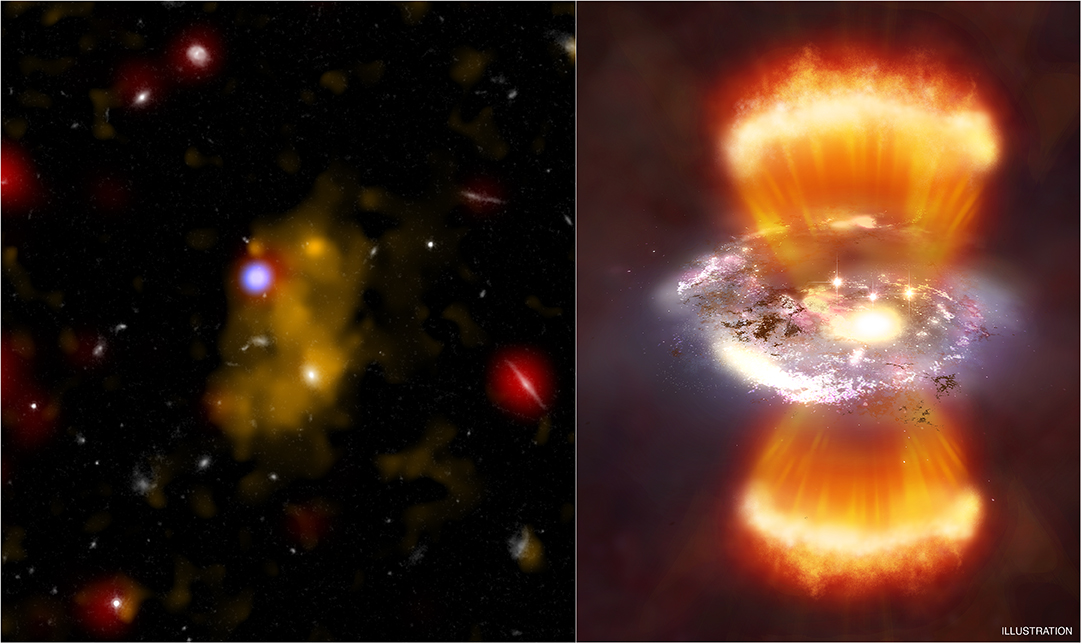
Lyman Alpha Blobs:
Lyman Alpha Blobs: Galaxies Coming of Age in Cosmic Blobs
Credit: Left panel: X-ray (NASA/CXC/Durham Univ./D.Alexander et al.); Optical (NASA/ESA/STScI/IoA/S.Chapman et al.); Lyman-alpha Optical (NAOJ/Subaru/Tohoku Univ./T.Hayashino et al.); Infrared (NASA/JPL-Caltech/Durham Univ./J.Geach et al.); Right, Illustration: NASA/CXC/M.Weiss
Using Chandra, growing supermassive black holes have been discovered in a sample of blobs, immense reservoirs of hydrogen gas located in the early Universe.
These black holes and bursts of star formation are believed to be illuminating and heating the gas in the blobs.
This represents a "coming of age" for the galaxies and black holes as they start to switch off their rapid growth.
A deep study of 29 gigantic blobs of hydrogen gas has been carried out with NASA's Chandra X-ray Observatory to identify the source of immense energy required to illuminate these structures. These mysterious blobs - called "Lyman-alpha blobs" by astronomers because of the light they emit - are several hundred thousand light years across and are seen when the Universe is only about two billion years old, or about 15% of its current age.
The composite image on the left shows one of the largest blobs observed in this study. Glowing hydrogen gas in the blob is shown by a Lyman-alpha optical image (colored yellow) from the National Astronomy Observatory of Japan's Subaru telescope. A galaxy located in the blob is visible in a broadband optical image (white) from the Hubble Space Telescope and an infrared image from the Spitzer Space Telescope (red). Finally, the Chandra X-ray Observatory image in blue shows evidence for a growing supermassive black hole in the center of the galaxy. Radiation and outflows from this active black hole are powerful enough to light up and heat the gas in the blob. Radiation and winds from rapid star formation occurring in the galaxy is believed to have similar effects. Clear evidence for four other active black holes in blobs is also seen.
The artist's representation on the right shows what one of the galaxies inside a blob might look like if viewed at a relatively close distance. A two-sided outflow powered by the supermassive black hole buried inside the middle of the galaxy is shown in bright yellow, above and below the spiral arms of the galaxy. This outflow illuminates and heats gas surrounding the galaxy. Radiation from regions close to the black hole will also play a significant role in lighting up and heating the blob. Stars are forming at a rapid rate in this galaxy, and young stars are being destroyed in supernova explosions. The three bright stars above the central bulge of the galaxy are examples of such supernovas (a companion illustration shows the effects of such explosions).
These new results show how blobs fit into the cosmic story of how galaxies and black holes evolve. Galaxies are believed to form when gas flows inwards under the pull of gravity and cools by emitting radiation. This process should stop when the gas is heated by radiation and outflows from galaxies and their black holes. Blobs could be a sign of this first stage, or of the second.
Based on the new data and theoretical arguments, Geach and his colleagues show that heating of gas by growing supermassive black holes and bursts of star formation, rather than cooling of gas, most likely powers the blobs. The implication is that blobs represent a stage when the galaxies and black holes are just starting to switch off their rapid growth because of these heating processes. This is a crucial stage of the evolution of galaxies and black holes -- known as "feedback" -- and one that astronomers have long been trying to understand.
Credit: Left panel: X-ray (NASA/CXC/Durham Univ./D.Alexander et al.); Optical (NASA/ESA/STScI/IoA/S.Chapman et al.); Lyman-alpha Optical (NAOJ/Subaru/Tohoku Univ./T.Hayashino et al.); Infrared (NASA/JPL-Caltech/Durham Univ./J.Geach et al.); Right, Illustration: NASA/CXC/M.Weiss
Using Chandra, growing supermassive black holes have been discovered in a sample of blobs, immense reservoirs of hydrogen gas located in the early Universe.
These black holes and bursts of star formation are believed to be illuminating and heating the gas in the blobs.
This represents a "coming of age" for the galaxies and black holes as they start to switch off their rapid growth.
A deep study of 29 gigantic blobs of hydrogen gas has been carried out with NASA's Chandra X-ray Observatory to identify the source of immense energy required to illuminate these structures. These mysterious blobs - called "Lyman-alpha blobs" by astronomers because of the light they emit - are several hundred thousand light years across and are seen when the Universe is only about two billion years old, or about 15% of its current age.
The composite image on the left shows one of the largest blobs observed in this study. Glowing hydrogen gas in the blob is shown by a Lyman-alpha optical image (colored yellow) from the National Astronomy Observatory of Japan's Subaru telescope. A galaxy located in the blob is visible in a broadband optical image (white) from the Hubble Space Telescope and an infrared image from the Spitzer Space Telescope (red). Finally, the Chandra X-ray Observatory image in blue shows evidence for a growing supermassive black hole in the center of the galaxy. Radiation and outflows from this active black hole are powerful enough to light up and heat the gas in the blob. Radiation and winds from rapid star formation occurring in the galaxy is believed to have similar effects. Clear evidence for four other active black holes in blobs is also seen.
The artist's representation on the right shows what one of the galaxies inside a blob might look like if viewed at a relatively close distance. A two-sided outflow powered by the supermassive black hole buried inside the middle of the galaxy is shown in bright yellow, above and below the spiral arms of the galaxy. This outflow illuminates and heats gas surrounding the galaxy. Radiation from regions close to the black hole will also play a significant role in lighting up and heating the blob. Stars are forming at a rapid rate in this galaxy, and young stars are being destroyed in supernova explosions. The three bright stars above the central bulge of the galaxy are examples of such supernovas (a companion illustration shows the effects of such explosions).
These new results show how blobs fit into the cosmic story of how galaxies and black holes evolve. Galaxies are believed to form when gas flows inwards under the pull of gravity and cools by emitting radiation. This process should stop when the gas is heated by radiation and outflows from galaxies and their black holes. Blobs could be a sign of this first stage, or of the second.
Based on the new data and theoretical arguments, Geach and his colleagues show that heating of gas by growing supermassive black holes and bursts of star formation, rather than cooling of gas, most likely powers the blobs. The implication is that blobs represent a stage when the galaxies and black holes are just starting to switch off their rapid growth because of these heating processes. This is a crucial stage of the evolution of galaxies and black holes -- known as "feedback" -- and one that astronomers have long been trying to understand.
17 Mayıs 2009 Pazar
QUIET team to deploy new gravity-wave probe in June
May 15,2009
A tiny fraction of a second following the big bang, the universe allegedly experienced the most inflationary period it has ever known.
During this inflationary era, space expanded faster than the speed of light. It sounds crazy, but it fits a variety of cosmological observations made in recent years, said University of Chicago physicist Bruce Winstein.
"Theorists take it to be true, but we have to prove it," said Winstein, the Samuel K. Allison Distinguished Service Professor in Physics at the University of Chicago. "It needs a real test, and that test is whether or not gravity waves were created."
Winstein and his Chicago associates are part of the international QUIET (Q/U Imaging ExperimenT; the Q and U stand for radiation parameters called Stokes parameters) collaboration that has devised such a test.
QUIET's goal: detect remnants of the radiation emitted at the earliest moments of the universe, when gravity waves rippled through the very fabric of space-time itself.
The intensive gravitational fields that existed at these earliest moments, according to Einstein, produced gravity waves that alternatively compressed and expanded space, first in one direction, then another. The cosmic microwave background (CMB) radiation—the afterglow of the big bang—may still carry a faint signature of those gravitational waves, nearly 14 billion years after their creation.
Seeking ethereal quarryOther collaborations, including the South Pole Telescope (SPT), seek the same ethereal quarry with different techniques. The University of Chicago's Kavli Institute of Cosmological Physics supports both projects.
"No one can say what the best approach is right now," Winstein said, "but we need a variety of attacks on this important problem, and ours is different from most of the others. It's very exciting to be in this game."
At stake is the potential elucidation of new physics, that which falls outside the scope of the standard model. This model, a set of theories that describes the behavior of matter and energy in the universe, cannot explain how points in the sky too far away to have ever been in contact have almost exactly the same temperature. A validation of inflation would solve that problem.
"If we see these gravity waves, they have been called the smoking gun of inflation," Winstein said.
The QUIET experiment began operating last October with an antenna array that contains 19 detectors. Since then, QUIET collaborators at the Jet Propulsion Laboratory in California have produced 91 detectors sensitive to the radiation at a higher frequency.
Over the past several months, the Chicago collaboration has assembled and calibrated these 91 detectors in the basement of the Laboratory for Astrophysics and Space Research.
Winstein's team has tested each detector, adjusting 10 critical voltages for each to yield the best performance. Correctly optimized voltages can improve detector performance by a large factor, Winstein said, making it possible to observe in one day what would have otherwise required a week. This newer, more sensitive array will begin operating in June.
High and dry operationThe QUIET experiment operates in Chile's Atacama Desert, at an altitude of 17,000 feet. "It's very dry, and that's important because this microwave radiation gets absorbed by water vapor," Winstein explained. "And we observe day and night, 10 to 11 months a year."
Observations will continue at least until the end of this year. The team must keep its detectors at a chilling minus 253 degrees Celsius (minus 423 degrees Fahrenheit, close to absolute zero) to boost the odds of detecting the extremely weak gravity-wave signals. These signals would be so weak that electronic noise could easily drown them out.
"One way to eliminate electronic noise is to get your detector very, very cold," said QUIET's Allison Brizius, a graduate student in physics. "The colder it gets, the quieter it gets, the better it can pick up a signal."
The QUIET experiment must both detect and amplify the signal, which puts out only about a billionth of a volt.
"We have to be very careful with such small signals not to introduce any other noise," Winstein said. "We've demonstrated that this technology works, and we're proposing to mass-produce these modules, nearly 2,000 of them."
Winstein comes from a particle physics background, a veteran of 30 years of experimental research at Fermi National Accelerator Laboratory, which also plays a role in QUIET. As a particle physicist, he was exploring physics at the highest energies that an accelerator could then achieve.
Now, as a cosmological physicist probing the CMB, he stands on the brink of reaching nearly to the Planck scale, the highest energies that the universe can create. The CMB, he said, is "probably our best handle on the overall structure of the universe and how it was born."
Related links:
Bruce Winstein
QUIET's home page
The South Pole Telescope and gravity waves
A tiny fraction of a second following the big bang, the universe allegedly experienced the most inflationary period it has ever known.
During this inflationary era, space expanded faster than the speed of light. It sounds crazy, but it fits a variety of cosmological observations made in recent years, said University of Chicago physicist Bruce Winstein.
"Theorists take it to be true, but we have to prove it," said Winstein, the Samuel K. Allison Distinguished Service Professor in Physics at the University of Chicago. "It needs a real test, and that test is whether or not gravity waves were created."
Winstein and his Chicago associates are part of the international QUIET (Q/U Imaging ExperimenT; the Q and U stand for radiation parameters called Stokes parameters) collaboration that has devised such a test.
QUIET's goal: detect remnants of the radiation emitted at the earliest moments of the universe, when gravity waves rippled through the very fabric of space-time itself.
The intensive gravitational fields that existed at these earliest moments, according to Einstein, produced gravity waves that alternatively compressed and expanded space, first in one direction, then another. The cosmic microwave background (CMB) radiation—the afterglow of the big bang—may still carry a faint signature of those gravitational waves, nearly 14 billion years after their creation.
Seeking ethereal quarryOther collaborations, including the South Pole Telescope (SPT), seek the same ethereal quarry with different techniques. The University of Chicago's Kavli Institute of Cosmological Physics supports both projects.
"No one can say what the best approach is right now," Winstein said, "but we need a variety of attacks on this important problem, and ours is different from most of the others. It's very exciting to be in this game."
At stake is the potential elucidation of new physics, that which falls outside the scope of the standard model. This model, a set of theories that describes the behavior of matter and energy in the universe, cannot explain how points in the sky too far away to have ever been in contact have almost exactly the same temperature. A validation of inflation would solve that problem.
"If we see these gravity waves, they have been called the smoking gun of inflation," Winstein said.
The QUIET experiment began operating last October with an antenna array that contains 19 detectors. Since then, QUIET collaborators at the Jet Propulsion Laboratory in California have produced 91 detectors sensitive to the radiation at a higher frequency.
Over the past several months, the Chicago collaboration has assembled and calibrated these 91 detectors in the basement of the Laboratory for Astrophysics and Space Research.
Winstein's team has tested each detector, adjusting 10 critical voltages for each to yield the best performance. Correctly optimized voltages can improve detector performance by a large factor, Winstein said, making it possible to observe in one day what would have otherwise required a week. This newer, more sensitive array will begin operating in June.
High and dry operationThe QUIET experiment operates in Chile's Atacama Desert, at an altitude of 17,000 feet. "It's very dry, and that's important because this microwave radiation gets absorbed by water vapor," Winstein explained. "And we observe day and night, 10 to 11 months a year."
Observations will continue at least until the end of this year. The team must keep its detectors at a chilling minus 253 degrees Celsius (minus 423 degrees Fahrenheit, close to absolute zero) to boost the odds of detecting the extremely weak gravity-wave signals. These signals would be so weak that electronic noise could easily drown them out.
"One way to eliminate electronic noise is to get your detector very, very cold," said QUIET's Allison Brizius, a graduate student in physics. "The colder it gets, the quieter it gets, the better it can pick up a signal."
The QUIET experiment must both detect and amplify the signal, which puts out only about a billionth of a volt.
"We have to be very careful with such small signals not to introduce any other noise," Winstein said. "We've demonstrated that this technology works, and we're proposing to mass-produce these modules, nearly 2,000 of them."
Winstein comes from a particle physics background, a veteran of 30 years of experimental research at Fermi National Accelerator Laboratory, which also plays a role in QUIET. As a particle physicist, he was exploring physics at the highest energies that an accelerator could then achieve.
Now, as a cosmological physicist probing the CMB, he stands on the brink of reaching nearly to the Planck scale, the highest energies that the universe can create. The CMB, he said, is "probably our best handle on the overall structure of the universe and how it was born."
Related links:
Bruce Winstein
QUIET's home page
The South Pole Telescope and gravity waves
13 Mart 2009 Cuma
CERNLAND
Geneva, 13 March 2009. Web veteran Robert Cailliau today launchedCERNland, a new website for young people, on the occasion of the Web's20th anniversary. CERNland has been developed to bring the excitement ofCERN*'s research to a young audience aged 7 to 12 through a range offilms, games and multimedia applications. It is available athttp://www.cern.ch/cernland
11 Mart 2009 Çarşamba
Precision measurement of W boson mass:
Precision measurement of W boson mass:photos and graphics
Click on links below images for medium and high-resolution jpeg images. When using these images, please credit them as specified.
Med Res Hi Res
The Standard Model describes the interactions of the fundamental particle of the world around us. Experimental observations agree with the predictions of the Standard Model with high precision. The W boson, the carrier of the electroweak force, is a key element in these predictions. Its mass is a fundamental parameter relevant for many predictions, including the energy emitted by our sun to the mass of the elusive Standard Model Higgs boson, which provides elementary particles with mass. Credit: Fermilab
Med Res Hi Res
Fermilab's DZero collaboration obtained the world’s most precise W mass value measured by a single experiment and announced its result at the annual conference on Electroweak Interactions and Unified Theories known as Rencontres de Moriond on March 8. Physicist Jan Stark, of the Laboratoire de Physique Subatomique in Grenoble, France, presented the result. Credit: DZero collaboration
Med Res Hi Res
The DZero collaboration comprises about 550 scientists from 18 countries who designed and built the 5,500-ton DZero detector and now collect and reconstruct collision data. They research a wide range of Standard Model topics and search for new subatomic phenomena. Credit: DZero collaboration
Med Res Hi Res
The Fermilab accelerator complex accelerates protons and antiprotons close to the speed of light. The Tevatron collider, four miles in circumference, produces millions of proton-antiproton collisions per second, maximizing the chance for discovery. Two experiments, CDF and DZero, record the collisions to look for signs of new particles and subatomic processes. Credit: Fermilab
Med Res Hi Res
The DZero detector records particles emerging from high-energy proton-antiproton collisions produced by the Tevatron. For the W mass precision measurement, the DZero collaboration analyzed about 500,000 decays of W bosons into electrons and neutrinos and determined the particle's mass with a precision of 0.05 percent. Credit: Fermilab
Click on links below images for medium and high-resolution jpeg images. When using these images, please credit them as specified.
Med Res Hi Res
The Standard Model describes the interactions of the fundamental particle of the world around us. Experimental observations agree with the predictions of the Standard Model with high precision. The W boson, the carrier of the electroweak force, is a key element in these predictions. Its mass is a fundamental parameter relevant for many predictions, including the energy emitted by our sun to the mass of the elusive Standard Model Higgs boson, which provides elementary particles with mass. Credit: Fermilab
Med Res Hi Res
Fermilab's DZero collaboration obtained the world’s most precise W mass value measured by a single experiment and announced its result at the annual conference on Electroweak Interactions and Unified Theories known as Rencontres de Moriond on March 8. Physicist Jan Stark, of the Laboratoire de Physique Subatomique in Grenoble, France, presented the result. Credit: DZero collaboration
Med Res Hi Res
The DZero collaboration comprises about 550 scientists from 18 countries who designed and built the 5,500-ton DZero detector and now collect and reconstruct collision data. They research a wide range of Standard Model topics and search for new subatomic phenomena. Credit: DZero collaboration
Med Res Hi Res
The Fermilab accelerator complex accelerates protons and antiprotons close to the speed of light. The Tevatron collider, four miles in circumference, produces millions of proton-antiproton collisions per second, maximizing the chance for discovery. Two experiments, CDF and DZero, record the collisions to look for signs of new particles and subatomic processes. Credit: Fermilab
Med Res Hi Res
The DZero detector records particles emerging from high-energy proton-antiproton collisions produced by the Tevatron. For the W mass precision measurement, the DZero collaboration analyzed about 500,000 decays of W bosons into electrons and neutrinos and determined the particle's mass with a precision of 0.05 percent. Credit: Fermilab
9 Mart 2009 Pazartesi
Precision measurement of W boson mass portends stricter limits for Higgs
Batavia, Ill.--Scientists of the CDF and DZero collaborations at theDepartment of Energy's Fermi National Accelerator Laboratory have observedparticle collisions that produce single top quarks. The discovery of thesingle top confirms important parameters of particle physics, includingthe total number of quarks, and has significance for the ongoing searchfor the Higgs particle at Fermilab's Tevatron, currently the world's mostpowerful operating particle accelerator.Previously, top quarks had only been observed when produced by the strongnuclear force. That interaction leads to the production of pairs of topquarks. The production of single top quarks, which involves the weaknuclear force and is harder to identify experimentally, has now beenobserved, almost 14 years to the day of the top quark discovery in 1995.Searching for single-top production makes finding a needle in a haystacklook easy. Only one in every 20 billion proton-antiproton collisionsproduces a single top quark. Even worse, the signal of these rareoccurrences is easily mimicked by other "background" processes that occurat much higher rates."Observation of the single top quark production is an important milestonefor the Tevatron program," said Dr. Dennis Kovar, Associate Director ofthe Office of Science for High Energy Physics at the U.S. Department ofEnergy. "Furthermore, the highly sensitive and successful analysis is animportant step in the search for the Higgs."Discovering the single top quark production presents challenges similar tothe Higgs boson search in the need to extract an extremely small signalfrom a very large background. Advanced analysis techniques pioneered forthe single top discovery are now in use for the Higgs boson search. Inaddition, the single top and the Higgs signals have backgrounds in common,and the single top is itself a background for the Higgs particle.To make the single-top discovery, physicists of the CDF and DZerocollaborations spent years combing independently through the results ofproton-antiproton collisions recorded by their experiments, respectively.Each team identified several thousand collision events that looked the wayexperimenters expect single top events to appear. Sophisticatedstatistical analysis and detailed background modeling showed that a fewhundred collision events produced the real thing. On March 4, the twoteams submitted their independent results to Physical Review Letters.The two collaborations earlier had reported preliminary results on thesearch for the single top. Since then, experimenters have more thandoubled the amount of data analyzed and sharpened selection and analysistechniques, making the discovery possible. For each experiment, theprobability that background events have faked the signal is now only onein nearly four million, allowing both collaborations to claim a bona fidediscovery that paves the way to more discoveries."I am thrilled that CDF and DZero achieved this goal," said FermilabDirector Pier Oddone. "The two collaborations have been searching for thisrare process for the last fifteen years, starting before the discovery ofthe top quark in 1995. Investigating these subatomic processes in moredetail may open a window onto physics phenomena beyond the StandardModel."Media Contacts:Judy Jackson, Fermilab, +1-630-840-3351, http://tr.mc371.mail.yahoo.com/mc/compose?to=jjackson@fnal.govKurt Riesselmann, Fermilab, +1-630-840-3351, http://tr.mc371.mail.yahoo.com/mc/compose?to=kurtr@fnal.govGraphics and photos are available at:http://www.fnal.gov/pub/presspass/images/Single-Top-Quark-2009.htmlNotes for Editors:Fermilab, the U.S. Department of Energy's Fermi National AcceleratorLaboratory located near Chicago, operates the Tevatron, the world'shighest-energy particle collider. The Fermi Research Alliance LLC operatesFermilab under a contract with DOE.CDF is an international experiment of 635 physicists from 63 institutionsin 15 countries. DZero is an international experiment conducted by 600physicists from 90 institutions in 18 countries. Funding for the CDF andDZero experiments comes from DOE's Office of Science, the National ScienceFoundation, and a number of international funding agencies.CDF collaborating institutions are athttp://www-cdf.fnal.gov/collaboration/index.htmlDZero collaborating institutions are athttp://www-d0.fnal.gov/ib/Institutions.htmlCopies of the two scientific papers submitted to Physical Review Lettersare available at: * http://arxiv.org/PS_cache/arxiv/pdf/0903/0903.0885v1.pdf * http://arxiv.org/PS_cache/arxiv/pdf/0903/0903.0850v1.pdfInterAction Collaboration media contacts:A full list of InterAction media contacts is available at:http://www.interactions.org/presscontacts/.
Fermilab collider experiments discover rare single top quark
Batavia, Ill.--Scientists of the CDF and DZero collaborations at theDepartment of Energy's Fermi National Accelerator Laboratory have observedparticle collisions that produce single top quarks. The discovery of thesingle top confirms important parameters of particle physics, includingthe total number of quarks, and has significance for the ongoing searchfor the Higgs particle at Fermilab's Tevatron, currently the world's mostpowerful operating particle accelerator.Previously, top quarks had only been observed when produced by the strongnuclear force. That interaction leads to the production of pairs of topquarks. The production of single top quarks, which involves the weaknuclear force and is harder to identify experimentally, has now beenobserved, almost 14 years to the day of the top quark discovery in 1995.Searching for single-top production makes finding a needle in a haystacklook easy. Only one in every 20 billion proton-antiproton collisionsproduces a single top quark. Even worse, the signal of these rareoccurrences is easily mimicked by other "background" processes that occurat much higher rates."Observation of the single top quark production is an important milestonefor the Tevatron program," said Dr. Dennis Kovar, Associate Director ofthe Office of Science for High Energy Physics at the U.S. Department ofEnergy. "Furthermore, the highly sensitive and successful analysis is animportant step in the search for the Higgs."Discovering the single top quark production presents challenges similar tothe Higgs boson search in the need to extract an extremely small signalfrom a very large background. Advanced analysis techniques pioneered forthe single top discovery are now in use for the Higgs boson search. Inaddition, the single top and the Higgs signals have backgrounds in common,and the single top is itself a background for the Higgs particle.To make the single-top discovery, physicists of the CDF and DZerocollaborations spent years combing independently through the results ofproton-antiproton collisions recorded by their experiments, respectively.Each team identified several thousand collision events that looked the wayexperimenters expect single top events to appear. Sophisticatedstatistical analysis and detailed background modeling showed that a fewhundred collision events produced the real thing. On March 4, the twoteams submitted their independent results to Physical Review Letters.The two collaborations earlier had reported preliminary results on thesearch for the single top. Since then, experimenters have more thandoubled the amount of data analyzed and sharpened selection and analysistechniques, making the discovery possible. For each experiment, theprobability that background events have faked the signal is now only onein nearly four million, allowing both collaborations to claim a bona fidediscovery that paves the way to more discoveries."I am thrilled that CDF and DZero achieved this goal," said FermilabDirector Pier Oddone. "The two collaborations have been searching for thisrare process for the last fifteen years, starting before the discovery ofthe top quark in 1995. Investigating these subatomic processes in moredetail may open a window onto physics phenomena beyond the StandardModel."Media Contacts:Judy Jackson, Fermilab, +1-630-840-3351, jjackson@fnal.govKurt Riesselmann, Fermilab, +1-630-840-3351, kurtr@fnal.govGraphics and photos are available at:http://www.fnal.gov/pub/presspass/images/Single-Top-Quark-2009.htmlNotes for Editors:Fermilab, the U.S. Department of Energy's Fermi National AcceleratorLaboratory located near Chicago, operates the Tevatron, the world'shighest-energy particle collider. The Fermi Research Alliance LLC operatesFermilab under a contract with DOE.CDF is an international experiment of 635 physicists from 63 institutionsin 15 countries. DZero is an international experiment conducted by 600physicists from 90 institutions in 18 countries. Funding for the CDF andDZero experiments comes from DOE's Office of Science, the National ScienceFoundation, and a number of international funding agencies.CDF collaborating institutions are athttp://www-cdf.fnal.gov/collaboration/index.htmlDZero collaborating institutions are athttp://www-d0.fnal.gov/ib/Institutions.htmlCopies of the two scientific papers submitted to Physical Review Lettersare available at: * http://arxiv.org/PS_cache/arxiv/pdf/0903/0903.0885v1.pdf * http://arxiv.org/PS_cache/arxiv/pdf/0903/0903.0850v1.pdfInterAction Collaboration media contacts:A full list of InterAction media contacts is available at:http://www.interactions.org/presscontacts/.
3 Mart 2009 Salı
Kepler's Supernova Remnant:
Using NASA's Chandra X-ray Observatory, scientists have created a stunning new image of one of the youngest supernova remnants in the galaxy. This new view of the debris of an exploded star helps astronomers solve a long-standing mystery, with implications for understanding how a star's life can end catastrophically and for gauging the expansion of the universe.
Over 400 years ago, sky watchers -- including the famous astronomer Johannes Kepler -- noticed a bright new object in the night sky. Since the telescope had not yet been invented, only the unaided eye could be used to watch as a new star that was initially brighter than Jupiter dimmed over the following weeks.
Chandra's latest image marks a new phase in understanding the object now known as Kepler's supernova remnant. By combining nearly nine days of Chandra observations, astronomers have generated an X-ray image with unprecedented detail of one of the brightest recorded supernovas in the Milky Way galaxy.
The explosion of the star that created the Kepler remnant blasted the stellar remains into space, heating the gases to millions of degrees and generating highly energized particles. Copious X-ray light, like that shining from many supernova remnants, was produced.
Astronomers have studied Kepler intensively over the past three decades with radio, optical and X-ray telescopes, but its origin has remained a puzzle. On the one hand, the presence of large amounts of iron and the absence of a detectable neutron star points toward a so-called Type Ia supernova. These events occur when a white dwarf star pulls material from an orbiting companion until the white dwarf becomes unstable and is destroyed by a thermonuclear explosion.
On the other hand, when viewed in optical light, the supernova remnant appears to be expanding into dense material that is rich in nitrogen. This would suggest Kepler belongs to a different type of supernova (known as "Type II") that is created from the collapse of a single massive star that sheds material before exploding. Type Ia supernovas do not normally have such surroundings.
A team of astronomers, led by Stephen Reynolds of North Carolina State University in Raleigh, N.C., was able to use the Chandra dataset to address this mystery. By comparing the relative amounts of oxygen and iron atoms in the supernova, the scientists were able to determine that Kepler resulted from a Type Ia supernova.
In solving the mystery of Kepler's identity, Reynolds and his team have also given an explanation for the dense material in the remnant. Kepler could be the nearest example of a relatively rare "prompt" Type Ia explosion, which occur in more massive progenitors only about 100 million years after the star formed rather than several billion years. If that is the case, Kepler could teach astronomers more about all Type Ia supernovas and the ways in which prompt explosions from massive stars differ from their more common cousins associated with lower mass stars. This information is essential to improve the reliability of the use of Type Ia stars as "standard candles" for cosmological studies of dark energy as well as to understand their role as the source of most of the iron in the universe.
In the new Chandra Kepler image, red represents low-energy X-rays and shows material around the star -- dominated by oxygen -- that has been heated up by a blast wave from the star's explosion. The yellow color shows slightly higher energy X-rays, mostly iron formed in the supernova, while green (medium-energy X-rays) shows other elements from the exploded star. The blue color represents the highest energy X-rays and shows a shock front generated by the explosion.
NASA's three Great Observatories -- the Hubble Space Telescope, the Spitzer Space Telescope, and the Chandra X-ray Observatory -- joined forces to probe the expanding remains of a supernova. Now known as Kepler's supernova remnant, this object was first seen 400 years ago by sky watchers, including famous astronomer Johannes Kepler.
The combined image unveils a bubble-shaped shroud of gas and dust that is 14 light years wide and is expanding at 4 million miles per hour (2,000 kilometers per second). Observations from each telescope highlight distinct features of the supernova remnant, a fast-moving shell of iron-rich material from the exploded star, surrounded by an expanding shock wave that is sweeping up interstellar gas and dust.
Each color in this image represents a different region of the electromagnetic spectrum, from X-rays to infrared light. These diverse colors are shown in the panel of photographs below the composite image. The X-ray and infrared data cannot be seen with the human eye. By color-coding those data and combining them with Hubble's visible-light view, astronomers are presenting a more complete picture of the supernova remnant.
Visible-light images from the Hubble telescope (colored yellow) reveal where the supernova shock wave is slamming into the densest regions of surrounding gas.
The bright glowing knots are dense clumps from instabilities that form behind the shock wave. The Hubble data also show thin filaments of gas that look like rippled sheets seen edge-on. These filaments reveal where the shock wave is encountering lower-density, more uniform interstellar material.
The Spitzer telescope shows microscopic dust particles (colored red) that have been heated by the supernova shock wave. The dust re-radiates the shock wave's energy as infrared light. The Spitzer data are brightest in the regions surrounding those seen in detail by the Hubble telescope.
The Chandra X-ray data show regions of very hot gas, and extremely high energy particles.
The hottest gas (higher-energy X-rays, colored blue) is located primarily in the regions directly behind the shock front. These regions also show up in the Hubble observations, and also align with the faint rim of glowing material seen in the Spitzer data. The X-rays from the region on the lower left (blue) may be dominated by extremely high energy electrons that were produced by the shock wave and are radiating at radio through X-ray wavelengths as they spiral in the intensified magnetic field behind the shock front. Cooler X-ray gas (lower-energy X-rays, colored green) resides in a thick interior shell and marks the location of heated material expelled from the exploded star.
The remnant of Kepler's supernova, the last such object seen to explode in our Milky Way galaxy (with the possible exception of the Cassiopeia A supernova, for which ambiguous sightings were reported around 1680), is located about 13,000 light years away in the constellation Ophiuchus.
The Chandra observations were taken in June 2000, the Hubble in August 2003, and the Spitzer in August 2004.
Over 400 years ago, sky watchers -- including the famous astronomer Johannes Kepler -- noticed a bright new object in the night sky. Since the telescope had not yet been invented, only the unaided eye could be used to watch as a new star that was initially brighter than Jupiter dimmed over the following weeks.
Chandra's latest image marks a new phase in understanding the object now known as Kepler's supernova remnant. By combining nearly nine days of Chandra observations, astronomers have generated an X-ray image with unprecedented detail of one of the brightest recorded supernovas in the Milky Way galaxy.
The explosion of the star that created the Kepler remnant blasted the stellar remains into space, heating the gases to millions of degrees and generating highly energized particles. Copious X-ray light, like that shining from many supernova remnants, was produced.
Astronomers have studied Kepler intensively over the past three decades with radio, optical and X-ray telescopes, but its origin has remained a puzzle. On the one hand, the presence of large amounts of iron and the absence of a detectable neutron star points toward a so-called Type Ia supernova. These events occur when a white dwarf star pulls material from an orbiting companion until the white dwarf becomes unstable and is destroyed by a thermonuclear explosion.
On the other hand, when viewed in optical light, the supernova remnant appears to be expanding into dense material that is rich in nitrogen. This would suggest Kepler belongs to a different type of supernova (known as "Type II") that is created from the collapse of a single massive star that sheds material before exploding. Type Ia supernovas do not normally have such surroundings.
A team of astronomers, led by Stephen Reynolds of North Carolina State University in Raleigh, N.C., was able to use the Chandra dataset to address this mystery. By comparing the relative amounts of oxygen and iron atoms in the supernova, the scientists were able to determine that Kepler resulted from a Type Ia supernova.
In solving the mystery of Kepler's identity, Reynolds and his team have also given an explanation for the dense material in the remnant. Kepler could be the nearest example of a relatively rare "prompt" Type Ia explosion, which occur in more massive progenitors only about 100 million years after the star formed rather than several billion years. If that is the case, Kepler could teach astronomers more about all Type Ia supernovas and the ways in which prompt explosions from massive stars differ from their more common cousins associated with lower mass stars. This information is essential to improve the reliability of the use of Type Ia stars as "standard candles" for cosmological studies of dark energy as well as to understand their role as the source of most of the iron in the universe.
In the new Chandra Kepler image, red represents low-energy X-rays and shows material around the star -- dominated by oxygen -- that has been heated up by a blast wave from the star's explosion. The yellow color shows slightly higher energy X-rays, mostly iron formed in the supernova, while green (medium-energy X-rays) shows other elements from the exploded star. The blue color represents the highest energy X-rays and shows a shock front generated by the explosion.
NASA's three Great Observatories -- the Hubble Space Telescope, the Spitzer Space Telescope, and the Chandra X-ray Observatory -- joined forces to probe the expanding remains of a supernova. Now known as Kepler's supernova remnant, this object was first seen 400 years ago by sky watchers, including famous astronomer Johannes Kepler.
The combined image unveils a bubble-shaped shroud of gas and dust that is 14 light years wide and is expanding at 4 million miles per hour (2,000 kilometers per second). Observations from each telescope highlight distinct features of the supernova remnant, a fast-moving shell of iron-rich material from the exploded star, surrounded by an expanding shock wave that is sweeping up interstellar gas and dust.
Each color in this image represents a different region of the electromagnetic spectrum, from X-rays to infrared light. These diverse colors are shown in the panel of photographs below the composite image. The X-ray and infrared data cannot be seen with the human eye. By color-coding those data and combining them with Hubble's visible-light view, astronomers are presenting a more complete picture of the supernova remnant.
Visible-light images from the Hubble telescope (colored yellow) reveal where the supernova shock wave is slamming into the densest regions of surrounding gas.
The bright glowing knots are dense clumps from instabilities that form behind the shock wave. The Hubble data also show thin filaments of gas that look like rippled sheets seen edge-on. These filaments reveal where the shock wave is encountering lower-density, more uniform interstellar material.
The Spitzer telescope shows microscopic dust particles (colored red) that have been heated by the supernova shock wave. The dust re-radiates the shock wave's energy as infrared light. The Spitzer data are brightest in the regions surrounding those seen in detail by the Hubble telescope.
The Chandra X-ray data show regions of very hot gas, and extremely high energy particles.
The hottest gas (higher-energy X-rays, colored blue) is located primarily in the regions directly behind the shock front. These regions also show up in the Hubble observations, and also align with the faint rim of glowing material seen in the Spitzer data. The X-rays from the region on the lower left (blue) may be dominated by extremely high energy electrons that were produced by the shock wave and are radiating at radio through X-ray wavelengths as they spiral in the intensified magnetic field behind the shock front. Cooler X-ray gas (lower-energy X-rays, colored green) resides in a thick interior shell and marks the location of heated material expelled from the exploded star.
The remnant of Kepler's supernova, the last such object seen to explode in our Milky Way galaxy (with the possible exception of the Cassiopeia A supernova, for which ambiguous sightings were reported around 1680), is located about 13,000 light years away in the constellation Ophiuchus.
The Chandra observations were taken in June 2000, the Hubble in August 2003, and the Spitzer in August 2004.
23 Şubat 2009 Pazartesi
The Quark-Hadron Transition in Cosmology and Dark Energy
Neşever BALTACI1
1 Umraniye Anatolia I.H.High School –Istanbul –Turkiye
e-mail : nesever@yahoo.com
Dark sides and golden ages Astronomers first started talking about a "golden age" of astrophysics and cosmology in the late 1990s. • Ironically, the outstanding questions in the golden age concern the dark side of the universe - what are the "dark matter" and the "dark energy" that cannot be seen but which make themselves known through their gravitational influence? •
But dark matter and dark energy are just two puzzles, albeit two extremely difficult and important ones, in a galaxy of questions that still new evidence has confirmed that the expansion of the universe is accelerating under the influence of a gravitationally repulsive form of energy that makes up two-thirds of the cosmos.
It is an irony of nature that the most abundant form of energy in the universe is also the most mysterious. Since the breakthrough discovery that the cosmic expansion is accelerating, a consistent picture has emerged indicating that two-thirds of the cosmos is made of "dark energy" - some sort of gravitationally repulsive material.
But is the evidence strong enough to justify exotic new laws of nature? Or could there be a simpler, astrophysical explanation for the results? The dark-energy story begins in 1998, when two independent teams of astronomers were searching for distant supernovae, hoping to measure the rate at which the expansion of the universe was slowing down. They were in for a shock: the observations showed that the expansion was speeding up
In fact, the universe started to accelerate long ago, some time in the last 10 billion years. Like detectives, cosmologists around the world have built up a description of the culprit responsible for the acceleration: it accounts for two-thirds of the cosmic energy density; it is gravitationally repulsive; it does not appear to cluster in galaxies; it was last seen stretching space–time apart; and it goes by the assumed name of "dark energy".
Many theorists already had a suspect in mind: the cosmological constant. It certainly fits the accelerating-expansion scenario. But is the case for dark energy airtight? The existence of gravitationally repulsive dark energy would have dramatic consequences for fundamental physics.
The most conservative suggestions are that the universe is filled with a uniform sea of quantum zero-point energy, or
a condensate of new particles that have a mass that is 10-39 times smaller than that of the electron.
Some researchers have also suggested changes to Einstein's general theory of relativity, such as a new long-range force that moderates the strength of gravity.
But there are shortcomings with even the leading conservative proposals. For instance, the zero-point energy density would have to be precisely tuned to a value that is an unbelievable factor of 10120 below the theoretical prediction. Until recently the supernova data were the only direct evidence for the cosmic acceleration, and the only compelling reason to accept dark energy. Precision measurements of the cosmic microwave background (CMB), including data from the Wilkinson Microwave Anisotropy Probe (WMAP), have recently provided circumstantial evidence for dark energy. The same is true of data from two extensive projects charting the large-scale distribution of galaxies - the Two-Degree Field (2DF) and Sloan Digital Sky Survey (SDSS)now a second witness has testified.
By combining data from WMAP, SDSS and other sources, four independent groups of researchers have reported evidence for a phenomenon known as the integrated Sachs-Wolfe effect. The case for the existence of dark energy has suddenly become a lot more convincing. One of the prime methods for measuring extragalactic distances is to use "standard candles" such as Cepheid variable stars , the total amount of matter in universe - including all the dark matter - accounts for just one-third of the total energy. This has been confirmed by surveys such as the 2DF and SDSS projects, which have mapped the positions and motions of millions of galaxies. But general relativity predicts that there is a precise connection between the expansion and the energy content of the universe. We therefore know that the collective energy density of all the photons, atoms, dark matter and everything else ought to add up to a certain critical value determined by the Hubble constant: ρcritical = 3H02/8π G, where G is the gravitational constant. The snag is that they do not. Mass, energy and the curvature of space-time are intimately related in relativity.
One explanation is therefore that the gap between the critical density and the actual matter density is filled by the equivalent energy density of a large-scale warping of space that is discernable only on scales approaching c/H0 (about 4000 Mpc).
In a universe where the full critical energy density comes from atoms and dark matter only, the weak gravitational potentials on very long length scales - which correspond to gentle waves in the matter density - evolve too slowly to leave a noticeable imprint on the CMB photons., gravitational collapse is slowed by the repulsive dark energy.
Consequently, gravitational potentials grow shallower and photons gain energy as they pass by. Similarly, photons lose energy passing through underdense regions. Negative pressure; to examine this strange property of dark energy it is helpful to introduce a quantity w = pdark/ρdark, where pdark is the mean pressure and ρdark is the density of dark energy in the universe. The rate of change in the cosmic expansion is proportional to -(ρtotal + 3ptotal), where ρtotal is the density of all the matter and energy in the universe and ptotal is the corresponding pressure. To account for the accelerated expansion, however, this quantity must be positive. Since ρtotal is a positive quantity, and the mean pressure due to both ordinary and dark matter is negligible because it is cold or non-relativistic, we arrive at the requirement that 3w x ρdark + ρtotal < 0 for an accelerating expansion. Since ρdark ~ 2/3ρtotal, we find that
w≥-1/2, so the pressure of the dark energy is not just a little negative but a lot negative!
Cartan torsion (The non-Riemannian geometry of macroscopic spin distributions in thermodynamics and ferromagnetism is obtained from the respective partition functions. An expression for the Cartan torsion in terms of the chemical potential is obtained. Analogies with the Einstein-Cartan theory of gravitation are discussed. From the partition function of ferromagnetism a spin-torsion relation analogous to the one obtained in Einstein-Cartan theory is given where piezomagnetic effects are taken into account) contribution to Sachs-Wolfe effect in the inflationary phase of the Universe is discussed. From the COBE data of the microwave anisotropy is possible to compute the spin-density in the Universe as 10^{16} mks units.The spin-density fluctuations at the hadron era (the Big Bang era when the Universe was matter-dominated, containing many hadrons in equilibrium with the radiation field and when kT ≈ mπ. The hadron era ended when the characteristic photon energy fell below the rest mass of a pion or π-meson (270 electron masses), and very few hadrons remained (about one hadron for every 108 photons).) is shown to coincide with the anisotropy temperature fluctuations
A transition from normal hadronic matter (such as protons and neutrons) to quark-gluon matter is expected at both high temperatures and densities. In physical situations, this transition may occur in heavy ion collisions, the early universe, and in the cores of neutron stars. Astrophysics and cosmology can be greatly affected by such a phase transition. With regard to the early universe, big bang nucleosynthesis, the theory describing the primordial origin of the light elements, can be affected by inhomogeneities produced during the transition. A transition to quark matter in the interior by neutron stars further enhances our uncertainties regarding the equation of state of dense nuclear matter and neutron star properties such as the maximum mass and rotation frequencies. Difficulties : higher energy scales
Planck era : ~ 10*77 GeV*4 GUT : ~ 10*64 GeV*4 Electroweak : ~ 10*8 GeV*4 QCD : ~ 10*-4 GeV*4
Puzzle Why rDE is so small ???
Quark-hadron phase transition The standard picture of cosmology assumes that a phase transition (associated with chiral symmetry breaking following the electroweak transition) occurred at approximately after the Big Bang to convert a plasma of free quarks and gluons into hadrons. Although this transition can be of significant cosmological importance, it is not known with certainty whether it is of first order or higher, and what the astrophysical consequences might be on the subsequent state of the Universe. For example, the transition may play a potentially observable role in the generation of primordial magnetic fields. The QCD transition may also give rise to important baryon number inhomogeneities which can affect the distribution of light element abundances from primordial Big Bang nucleosynthesis. The distribution of baryons may be influenced hydrodynamically by the competing effects of phase mixing and phase separation, which arise from any inherent instability of the interface surfaces separating regions of different phase. Unstable modes, if they exist, will distort phase boundaries and induce mixing and diffusive homogenization through hydrodynamic turbulence
In an effort to support and expand theoretical studies, a number of one-dimensional numerical simulations have been carried out to explore the behavior of growing hadron bubbles and decaying quark droplets in simplified and isolated geometries. For example, Rezolla et al. considered a first order phase transition and the nucleation of hadronic bubbles in a supercooled quark-gluon plasma, solving the relativistic Lagrangian equations for disconnected and evaporating quark regions during the final stages of the phase transition. They investigated numerically a single isolated quark drop with an initial radius large enough so that surface effects can be neglected. The droplet evolves as a self-similar solution until it evaporates to a sufficiently small radius that surface effects break the similarity solution and increase the evaporation rate. Their simulations indicate that, in neglecting long-range energy and momentum transfer (by electromagnetically interacting particles) and assuming that baryon number is transported with the hydrodynamical flux, the baryon number concentration is similar to what predicted by chemical equilibrium calculations.
Kurki-Suonio and Laine studied the growth of bubbles and the decay of droplets using a one-dimensional spherically symmetric code that accounts for a phenomenological model of the microscopic entropy generated at the phase transition surface. Incorporating the small scale effects of finite wall width and surface tension, but neglecting entropy and baryon flow through the droplet wall, they simulate the process by which nucleating bubbles grow and evolve to a similarity solution. They also compute the evaporation of quark droplets as they deviate from similarity solutions at late times due to surface tension and wall effects. Ignatius et al. carried out parameter studies of bubble growth for both the QCD and electroweak transitions in planar symmetry, demonstrating that hadron bubbles reach a stationary similarity state after a short time when bubbles grow at constant velocity. They investigated the stationary state using numerical and analytic methods, accounting also for preheating caused by shock fronts.
Figure 1:
Image sequence of the scalar field from a 2D calculation showing the interaction of two deflagration systems (one planar wall propagating from the right side, and one spherical bubble nucleating from the center). The physical size of the grid is set to and resolved by zones. The run time of the simulation is about two sound crossing times, where the sound speed is , so the shock fronts leading the condensing phase fronts travel across the grid twice. The hot quark (cold hadron) phases have smaller (larger) scalar field values and are represented by black (color) in the colormap.
Figure 2:
Image sequence of the scalar field from a 2D calculation showing the interaction of two detonation systems (one planar wall propagating from the right side, and one spherical bubble nucleating from the center). The physical size of the grid is set to and resolved by zones. The run time of the simulation is about two sound crossing times.
Figure 3:
Image sequence of the scalar field from a 2D calculation showing the interaction of shock and rarefaction waves with a deflagration wall (initiated at the left side) and a detonation wall (starting from the right). A shock and rarefaction wave travel to the right and left, respectively, from the temperature discontinuity located initially at the grid center (the right half of the grid is at a higher temperature). The physical size of the domain is set to and resolved by zones. The run time of the simulation is about two sound crossing times.
Fragile and Anninos performed two-dimensional simulations of first order QCD transitions to explore the nature of interface boundaries beyond linear stability analysis, and determine if they are stable when the full nonlinearities of the relativistic scalar field and hydrodynamic system of equations are accounted for. They used results from linear perturbation theory to define initial fluctuations on either side of the phase fronts and evolved the data numerically in time for both deflagration and detonation configurations. No evidence of mixing instabilities or hydrodynamic turbulence was found in any of the cases they considered, despite the fact that they investigated the parameter space predicted to be potentially unstable according to linear analysis. They also investigated whether phase mixing can occur through a turbulence-type mechanism triggered by shock proximity or disruption of phase fronts. They considered three basic cases (see image sequences in Figures 1, 2, and 3 above): interactions between planar and spherical deflagration bubbles, collisions between planar and spherical detonation bubbles, and a third case simulating the interaction between both deflagration and detonation systems initially at two different thermal states. Their results are consistent with the standard picture of cosmological phase transitions in which hadron bubbles expand as spherical condensation fronts, undergoing regular (non-turbulent) coalescence, and eventually leading to collapsing spherical quark droplets in a medium of hadrons. This is generally true even in the detonation cases which are complicated by greater entropy heating from shock interactions contributing to the irregular destruction of hadrons and the creation of quark nuggets.
However, Fragile and Anninos also note a deflagration ‘instability’ or acceleration mechanism evident in their third case for which they assume an initial thermal discontinuity in space separating different regions of nucleating hadron bubbles. The passage of a rarefaction wave (generated at the thermal discontinuity) through a slowly propagating deflagration can significantly accelerate the condensation process, suggesting that the dominant modes of condensation in an early Universe which super-cools at different rates within causally connected domains may be through supersonic detonations or fast moving (nearly sonic) deflagrations. A similar speculation was made by Kamionkowski and Freese who suggested that deflagrations become unstable to perturbations and are converted to detonations by turbulent surface distortion effects. However, in the simulations, deflagrations are accelerated not from turbulent mixing and surface distortion, but from enhanced super-cooling by rarefaction waves. In multi-dimensions, the acceleration mechanism can be exaggerated further by upwind phase mergers due to transverse flow, surface distortion, and mode dissipation effects, a combination that may result in supersonic front propagation speeds, even if the nucleation process began as a slowly propagating deflagration.
The Higgs is Different! All the matter particles are spin-1/2 fermions. All the force carriers are spin-1 bosons.
Higgs particles are spin-0 bosons. The Higgs is neither matter nor force; The Higgs is just different.
This would be the first fundamental scalar ever discovered. The Higgs field is thought to fill the entire universe.
Could give some handle of dark energy(scalar field)? Many modern theories predict other scalar particles like the Higgs.
Why, after all, should the Higgs be the only one of its kind? LHC and ILC can search for new scalars with precision.
This message contains blocked imagesOptions
References,
1)Robert R Caldwell is in the Department of Physics and Astronomy, Dartmouth College, 6127 Wilder Laboratory, Hanover, NH 03755-3528,
2) R R Caldwell and P J Steinhardt 2000 Quintessence Physics World November pp31-37
3)R P Kirshner 2000 The Extravagant Universe: Exploding Stars, Dark Energy, and the Accelerating Cosmos (Princeton University Press) 4)R A Knop et al. (The Supernova Cosmology Project) 2004 New constraints on Ωm, ΩΛ, and w from an independent set of eleven high-redshift supernovae observed with HST Astrophys. J. at press (arXiv.org/abs/astro-ph/0309368)
5)A G Riess et al. 2004 (The High-z Supernova Search Team) Type 1a supernova discoveries at z > 1 from the Hubble Space Telescope: evidence for past deceleration and constraints on dark energy evolution Astrophys. J at press (see arXiv.org/abs/astro-ph/0402512)
6)S Boughn and R Crittenden 2004 A correlation between the cosmic microwave background and large-scale structure in the universe Nature 427 45
7)P Fosalba et al. 2003 Detection of the ISW and SZ effects from the CMB-galaxy correlation Astrophys. J. 597 L89
8)M R Nolta et al. (WMAP Collaboration) 2004 First year Wilkinson Microwave Anisotropy Probe (WMAP) observations: dark energy induced correlation with radio sources Astrophys. J. at press . (arXiv.org/abs/astro-ph/0305097)
9)R Scranton et al. (SDSS Collaboration) 2003 Physical evidence for dark energy arXiv.org/abs/astro-ph/0307335
10)A Cooray et al. 2004 Growth rate of large-scale structure as a powerful probe of dark energy Phys. Rev. D 69 027301
11)Z Haiman et al. 2000 Constraints on quintessence from future galaxy cluster surveys Astrophys. J. 553 545
12)J Weller et al. 2002 Constraining dark energy with Sunyaev-Zel'dovich cluster surveys Phys. Rev. Lett. 88 231301
13)Kamionkowski, M., and Freese, K., “Instability and Subsequent Evolution of Electroweak Bubbles”, Phys. Rev. Lett., 69, 2743-2746, (1992).
14)Link, B., “Deflagration Instability in the Quark-Hadron Phase Transition”, Phys. Rev. Lett., 68, 2425-2428, (1992).
15)Huet, P., Kajantie, K., Leigh, R.G., Liu, B.H., and McLerran, L., “Hydrodynamic Stability Analysis of Burning Bubbles in Electroweak Theory and in QCD”, Phys. Rev. D, 48, 2477-2492, (1993).
16)Abney, M., “hydrodynamic Detonation Instability in Electroweak and QCD Phase Transitions”, Phys. Rev. D, 49, 1777-1782, (1994).
17)Rezzolla, L., “Stability of Cosmological Detonation Fronts”, Phys. Rev. D, 54, 1345-1358, (1996).
18)Rezzolla, L., Miller, J.C., and Pantano, O., “Evaporation of Quark Drops During the Cosmological Quark-Hadron Transition”, Phys. Rev. D, 52, 3202-3213, (1995).
19)Kurki-Suonio, H., and Laine, M., “On Bubble Growth and Droplet Decay in Cosmological Phase Transitions”, Phys. Rev. D, 54, 7163-7171, (1996).
20)Ignatius, J., Kajantie, K., Kurki-Suonio, H., and Laine, H., “Growth of Bubbles in Cosmological Phase Transitions”, Phys. Rev. D, 49, 3854-3868, (1994).
21)Fragile, P.C., and Anninos, P., “Hydrodynamic Stability of Cosmological Quark-Hadron Phase Transitions”, Phys. Rev. D, 67, 103010, (2003).
22)Kamionkowski, M., and Freese, K., “Instability and Subsequent Evolution of Electroweak Bubbles”, Phys. Rev. Lett., 69, 2743-2746, (1992).
23)R.-D. Heuer (Univ. Hamburg/DESY) ICFA Seminar 2005, Daegu, Korea,
24)What is the Universe Made Of?by Bob Orr
25)Eric Linder -Lawrence Berkeley National Laboratory
26) Dejjan Stojjkoviic-Case Western Reserve University-The OhioState UniversityColumbus,June2,2007
27)SibajiRahaBose Institute KolkataFebruary 7, 2005
Neşever BALTACI1
1 Umraniye Anatolia I.H.High School –Istanbul –Turkiye
e-mail : nesever@yahoo.com
Dark sides and golden ages Astronomers first started talking about a "golden age" of astrophysics and cosmology in the late 1990s. • Ironically, the outstanding questions in the golden age concern the dark side of the universe - what are the "dark matter" and the "dark energy" that cannot be seen but which make themselves known through their gravitational influence? •
But dark matter and dark energy are just two puzzles, albeit two extremely difficult and important ones, in a galaxy of questions that still new evidence has confirmed that the expansion of the universe is accelerating under the influence of a gravitationally repulsive form of energy that makes up two-thirds of the cosmos.
It is an irony of nature that the most abundant form of energy in the universe is also the most mysterious. Since the breakthrough discovery that the cosmic expansion is accelerating, a consistent picture has emerged indicating that two-thirds of the cosmos is made of "dark energy" - some sort of gravitationally repulsive material.
But is the evidence strong enough to justify exotic new laws of nature? Or could there be a simpler, astrophysical explanation for the results? The dark-energy story begins in 1998, when two independent teams of astronomers were searching for distant supernovae, hoping to measure the rate at which the expansion of the universe was slowing down. They were in for a shock: the observations showed that the expansion was speeding up
In fact, the universe started to accelerate long ago, some time in the last 10 billion years. Like detectives, cosmologists around the world have built up a description of the culprit responsible for the acceleration: it accounts for two-thirds of the cosmic energy density; it is gravitationally repulsive; it does not appear to cluster in galaxies; it was last seen stretching space–time apart; and it goes by the assumed name of "dark energy".
Many theorists already had a suspect in mind: the cosmological constant. It certainly fits the accelerating-expansion scenario. But is the case for dark energy airtight? The existence of gravitationally repulsive dark energy would have dramatic consequences for fundamental physics.
The most conservative suggestions are that the universe is filled with a uniform sea of quantum zero-point energy, or
a condensate of new particles that have a mass that is 10-39 times smaller than that of the electron.
Some researchers have also suggested changes to Einstein's general theory of relativity, such as a new long-range force that moderates the strength of gravity.
But there are shortcomings with even the leading conservative proposals. For instance, the zero-point energy density would have to be precisely tuned to a value that is an unbelievable factor of 10120 below the theoretical prediction. Until recently the supernova data were the only direct evidence for the cosmic acceleration, and the only compelling reason to accept dark energy. Precision measurements of the cosmic microwave background (CMB), including data from the Wilkinson Microwave Anisotropy Probe (WMAP), have recently provided circumstantial evidence for dark energy. The same is true of data from two extensive projects charting the large-scale distribution of galaxies - the Two-Degree Field (2DF) and Sloan Digital Sky Survey (SDSS)now a second witness has testified.
By combining data from WMAP, SDSS and other sources, four independent groups of researchers have reported evidence for a phenomenon known as the integrated Sachs-Wolfe effect. The case for the existence of dark energy has suddenly become a lot more convincing. One of the prime methods for measuring extragalactic distances is to use "standard candles" such as Cepheid variable stars , the total amount of matter in universe - including all the dark matter - accounts for just one-third of the total energy. This has been confirmed by surveys such as the 2DF and SDSS projects, which have mapped the positions and motions of millions of galaxies. But general relativity predicts that there is a precise connection between the expansion and the energy content of the universe. We therefore know that the collective energy density of all the photons, atoms, dark matter and everything else ought to add up to a certain critical value determined by the Hubble constant: ρcritical = 3H02/8π G, where G is the gravitational constant. The snag is that they do not. Mass, energy and the curvature of space-time are intimately related in relativity.
One explanation is therefore that the gap between the critical density and the actual matter density is filled by the equivalent energy density of a large-scale warping of space that is discernable only on scales approaching c/H0 (about 4000 Mpc).
In a universe where the full critical energy density comes from atoms and dark matter only, the weak gravitational potentials on very long length scales - which correspond to gentle waves in the matter density - evolve too slowly to leave a noticeable imprint on the CMB photons., gravitational collapse is slowed by the repulsive dark energy.
Consequently, gravitational potentials grow shallower and photons gain energy as they pass by. Similarly, photons lose energy passing through underdense regions. Negative pressure; to examine this strange property of dark energy it is helpful to introduce a quantity w = pdark/ρdark, where pdark is the mean pressure and ρdark is the density of dark energy in the universe. The rate of change in the cosmic expansion is proportional to -(ρtotal + 3ptotal), where ρtotal is the density of all the matter and energy in the universe and ptotal is the corresponding pressure. To account for the accelerated expansion, however, this quantity must be positive. Since ρtotal is a positive quantity, and the mean pressure due to both ordinary and dark matter is negligible because it is cold or non-relativistic, we arrive at the requirement that 3w x ρdark + ρtotal < 0 for an accelerating expansion. Since ρdark ~ 2/3ρtotal, we find that
w≥-1/2, so the pressure of the dark energy is not just a little negative but a lot negative!
Cartan torsion (The non-Riemannian geometry of macroscopic spin distributions in thermodynamics and ferromagnetism is obtained from the respective partition functions. An expression for the Cartan torsion in terms of the chemical potential is obtained. Analogies with the Einstein-Cartan theory of gravitation are discussed. From the partition function of ferromagnetism a spin-torsion relation analogous to the one obtained in Einstein-Cartan theory is given where piezomagnetic effects are taken into account) contribution to Sachs-Wolfe effect in the inflationary phase of the Universe is discussed. From the COBE data of the microwave anisotropy is possible to compute the spin-density in the Universe as 10^{16} mks units.The spin-density fluctuations at the hadron era (the Big Bang era when the Universe was matter-dominated, containing many hadrons in equilibrium with the radiation field and when kT ≈ mπ. The hadron era ended when the characteristic photon energy fell below the rest mass of a pion or π-meson (270 electron masses), and very few hadrons remained (about one hadron for every 108 photons).) is shown to coincide with the anisotropy temperature fluctuations
A transition from normal hadronic matter (such as protons and neutrons) to quark-gluon matter is expected at both high temperatures and densities. In physical situations, this transition may occur in heavy ion collisions, the early universe, and in the cores of neutron stars. Astrophysics and cosmology can be greatly affected by such a phase transition. With regard to the early universe, big bang nucleosynthesis, the theory describing the primordial origin of the light elements, can be affected by inhomogeneities produced during the transition. A transition to quark matter in the interior by neutron stars further enhances our uncertainties regarding the equation of state of dense nuclear matter and neutron star properties such as the maximum mass and rotation frequencies. Difficulties : higher energy scales
Planck era : ~ 10*77 GeV*4 GUT : ~ 10*64 GeV*4 Electroweak : ~ 10*8 GeV*4 QCD : ~ 10*-4 GeV*4
Puzzle Why rDE is so small ???
Quark-hadron phase transition The standard picture of cosmology assumes that a phase transition (associated with chiral symmetry breaking following the electroweak transition) occurred at approximately after the Big Bang to convert a plasma of free quarks and gluons into hadrons. Although this transition can be of significant cosmological importance, it is not known with certainty whether it is of first order or higher, and what the astrophysical consequences might be on the subsequent state of the Universe. For example, the transition may play a potentially observable role in the generation of primordial magnetic fields. The QCD transition may also give rise to important baryon number inhomogeneities which can affect the distribution of light element abundances from primordial Big Bang nucleosynthesis. The distribution of baryons may be influenced hydrodynamically by the competing effects of phase mixing and phase separation, which arise from any inherent instability of the interface surfaces separating regions of different phase. Unstable modes, if they exist, will distort phase boundaries and induce mixing and diffusive homogenization through hydrodynamic turbulence
In an effort to support and expand theoretical studies, a number of one-dimensional numerical simulations have been carried out to explore the behavior of growing hadron bubbles and decaying quark droplets in simplified and isolated geometries. For example, Rezolla et al. considered a first order phase transition and the nucleation of hadronic bubbles in a supercooled quark-gluon plasma, solving the relativistic Lagrangian equations for disconnected and evaporating quark regions during the final stages of the phase transition. They investigated numerically a single isolated quark drop with an initial radius large enough so that surface effects can be neglected. The droplet evolves as a self-similar solution until it evaporates to a sufficiently small radius that surface effects break the similarity solution and increase the evaporation rate. Their simulations indicate that, in neglecting long-range energy and momentum transfer (by electromagnetically interacting particles) and assuming that baryon number is transported with the hydrodynamical flux, the baryon number concentration is similar to what predicted by chemical equilibrium calculations.
Kurki-Suonio and Laine studied the growth of bubbles and the decay of droplets using a one-dimensional spherically symmetric code that accounts for a phenomenological model of the microscopic entropy generated at the phase transition surface. Incorporating the small scale effects of finite wall width and surface tension, but neglecting entropy and baryon flow through the droplet wall, they simulate the process by which nucleating bubbles grow and evolve to a similarity solution. They also compute the evaporation of quark droplets as they deviate from similarity solutions at late times due to surface tension and wall effects. Ignatius et al. carried out parameter studies of bubble growth for both the QCD and electroweak transitions in planar symmetry, demonstrating that hadron bubbles reach a stationary similarity state after a short time when bubbles grow at constant velocity. They investigated the stationary state using numerical and analytic methods, accounting also for preheating caused by shock fronts.
Figure 1:
Image sequence of the scalar field from a 2D calculation showing the interaction of two deflagration systems (one planar wall propagating from the right side, and one spherical bubble nucleating from the center). The physical size of the grid is set to and resolved by zones. The run time of the simulation is about two sound crossing times, where the sound speed is , so the shock fronts leading the condensing phase fronts travel across the grid twice. The hot quark (cold hadron) phases have smaller (larger) scalar field values and are represented by black (color) in the colormap.
Figure 2:
Image sequence of the scalar field from a 2D calculation showing the interaction of two detonation systems (one planar wall propagating from the right side, and one spherical bubble nucleating from the center). The physical size of the grid is set to and resolved by zones. The run time of the simulation is about two sound crossing times.
Figure 3:
Image sequence of the scalar field from a 2D calculation showing the interaction of shock and rarefaction waves with a deflagration wall (initiated at the left side) and a detonation wall (starting from the right). A shock and rarefaction wave travel to the right and left, respectively, from the temperature discontinuity located initially at the grid center (the right half of the grid is at a higher temperature). The physical size of the domain is set to and resolved by zones. The run time of the simulation is about two sound crossing times.
Fragile and Anninos performed two-dimensional simulations of first order QCD transitions to explore the nature of interface boundaries beyond linear stability analysis, and determine if they are stable when the full nonlinearities of the relativistic scalar field and hydrodynamic system of equations are accounted for. They used results from linear perturbation theory to define initial fluctuations on either side of the phase fronts and evolved the data numerically in time for both deflagration and detonation configurations. No evidence of mixing instabilities or hydrodynamic turbulence was found in any of the cases they considered, despite the fact that they investigated the parameter space predicted to be potentially unstable according to linear analysis. They also investigated whether phase mixing can occur through a turbulence-type mechanism triggered by shock proximity or disruption of phase fronts. They considered three basic cases (see image sequences in Figures 1, 2, and 3 above): interactions between planar and spherical deflagration bubbles, collisions between planar and spherical detonation bubbles, and a third case simulating the interaction between both deflagration and detonation systems initially at two different thermal states. Their results are consistent with the standard picture of cosmological phase transitions in which hadron bubbles expand as spherical condensation fronts, undergoing regular (non-turbulent) coalescence, and eventually leading to collapsing spherical quark droplets in a medium of hadrons. This is generally true even in the detonation cases which are complicated by greater entropy heating from shock interactions contributing to the irregular destruction of hadrons and the creation of quark nuggets.
However, Fragile and Anninos also note a deflagration ‘instability’ or acceleration mechanism evident in their third case for which they assume an initial thermal discontinuity in space separating different regions of nucleating hadron bubbles. The passage of a rarefaction wave (generated at the thermal discontinuity) through a slowly propagating deflagration can significantly accelerate the condensation process, suggesting that the dominant modes of condensation in an early Universe which super-cools at different rates within causally connected domains may be through supersonic detonations or fast moving (nearly sonic) deflagrations. A similar speculation was made by Kamionkowski and Freese who suggested that deflagrations become unstable to perturbations and are converted to detonations by turbulent surface distortion effects. However, in the simulations, deflagrations are accelerated not from turbulent mixing and surface distortion, but from enhanced super-cooling by rarefaction waves. In multi-dimensions, the acceleration mechanism can be exaggerated further by upwind phase mergers due to transverse flow, surface distortion, and mode dissipation effects, a combination that may result in supersonic front propagation speeds, even if the nucleation process began as a slowly propagating deflagration.
The Higgs is Different! All the matter particles are spin-1/2 fermions. All the force carriers are spin-1 bosons.
Higgs particles are spin-0 bosons. The Higgs is neither matter nor force; The Higgs is just different.
This would be the first fundamental scalar ever discovered. The Higgs field is thought to fill the entire universe.
Could give some handle of dark energy(scalar field)? Many modern theories predict other scalar particles like the Higgs.
Why, after all, should the Higgs be the only one of its kind? LHC and ILC can search for new scalars with precision.
This message contains blocked imagesOptions
References,
1)Robert R Caldwell is in the Department of Physics and Astronomy, Dartmouth College, 6127 Wilder Laboratory, Hanover, NH 03755-3528,
2) R R Caldwell and P J Steinhardt 2000 Quintessence Physics World November pp31-37
3)R P Kirshner 2000 The Extravagant Universe: Exploding Stars, Dark Energy, and the Accelerating Cosmos (Princeton University Press) 4)R A Knop et al. (The Supernova Cosmology Project) 2004 New constraints on Ωm, ΩΛ, and w from an independent set of eleven high-redshift supernovae observed with HST Astrophys. J. at press (arXiv.org/abs/astro-ph/0309368)
5)A G Riess et al. 2004 (The High-z Supernova Search Team) Type 1a supernova discoveries at z > 1 from the Hubble Space Telescope: evidence for past deceleration and constraints on dark energy evolution Astrophys. J at press (see arXiv.org/abs/astro-ph/0402512)
6)S Boughn and R Crittenden 2004 A correlation between the cosmic microwave background and large-scale structure in the universe Nature 427 45
7)P Fosalba et al. 2003 Detection of the ISW and SZ effects from the CMB-galaxy correlation Astrophys. J. 597 L89
8)M R Nolta et al. (WMAP Collaboration) 2004 First year Wilkinson Microwave Anisotropy Probe (WMAP) observations: dark energy induced correlation with radio sources Astrophys. J. at press . (arXiv.org/abs/astro-ph/0305097)
9)R Scranton et al. (SDSS Collaboration) 2003 Physical evidence for dark energy arXiv.org/abs/astro-ph/0307335
10)A Cooray et al. 2004 Growth rate of large-scale structure as a powerful probe of dark energy Phys. Rev. D 69 027301
11)Z Haiman et al. 2000 Constraints on quintessence from future galaxy cluster surveys Astrophys. J. 553 545
12)J Weller et al. 2002 Constraining dark energy with Sunyaev-Zel'dovich cluster surveys Phys. Rev. Lett. 88 231301
13)Kamionkowski, M., and Freese, K., “Instability and Subsequent Evolution of Electroweak Bubbles”, Phys. Rev. Lett., 69, 2743-2746, (1992).
14)Link, B., “Deflagration Instability in the Quark-Hadron Phase Transition”, Phys. Rev. Lett., 68, 2425-2428, (1992).
15)Huet, P., Kajantie, K., Leigh, R.G., Liu, B.H., and McLerran, L., “Hydrodynamic Stability Analysis of Burning Bubbles in Electroweak Theory and in QCD”, Phys. Rev. D, 48, 2477-2492, (1993).
16)Abney, M., “hydrodynamic Detonation Instability in Electroweak and QCD Phase Transitions”, Phys. Rev. D, 49, 1777-1782, (1994).
17)Rezzolla, L., “Stability of Cosmological Detonation Fronts”, Phys. Rev. D, 54, 1345-1358, (1996).
18)Rezzolla, L., Miller, J.C., and Pantano, O., “Evaporation of Quark Drops During the Cosmological Quark-Hadron Transition”, Phys. Rev. D, 52, 3202-3213, (1995).
19)Kurki-Suonio, H., and Laine, M., “On Bubble Growth and Droplet Decay in Cosmological Phase Transitions”, Phys. Rev. D, 54, 7163-7171, (1996).
20)Ignatius, J., Kajantie, K., Kurki-Suonio, H., and Laine, H., “Growth of Bubbles in Cosmological Phase Transitions”, Phys. Rev. D, 49, 3854-3868, (1994).
21)Fragile, P.C., and Anninos, P., “Hydrodynamic Stability of Cosmological Quark-Hadron Phase Transitions”, Phys. Rev. D, 67, 103010, (2003).
22)Kamionkowski, M., and Freese, K., “Instability and Subsequent Evolution of Electroweak Bubbles”, Phys. Rev. Lett., 69, 2743-2746, (1992).
23)R.-D. Heuer (Univ. Hamburg/DESY) ICFA Seminar 2005, Daegu, Korea,
24)What is the Universe Made Of?by Bob Orr
25)Eric Linder -Lawrence Berkeley National Laboratory
26) Dejjan Stojjkoviic-Case Western Reserve University-The OhioState UniversityColumbus,June2,2007
27)SibajiRahaBose Institute KolkataFebruary 7, 2005
RX1856-3754 NEUTRON STAR
represented by: Ayşe Banu BİRLİK Uludağ University Physics Departmant ; researching Jan, 2001-preparing May,2005
Supervisors; Neşever BALTACI-2001-2005 and M.Ali ALPAR 2001
Title:: AN ISOLATED and PROPELLER NEUTRON STAR RX J1856-3754
ABSTRACT
Comparing on RX J185635-3754 Neutron Star on optical and X-ray for 1° view with other rays taken from satallites and researching on where it borns calculating excess flux of RX J1856 optical flux (49eV) to x-ray blacbody flux (57eV) discussing AXPs ,SGRs, DNTs and RQNSs models for propeller neutron star.Comparing on datas which are taken from the satalites RASS-Cnt Broad,PSPC 2.0 Deg-Inten, Digitized Sky Survey, 1420 MHz (Bonn), GB6 (4850 Mhz), Old PSPC (2 deg), COBE DIRBE, IRAS 12 micron and 100 micron.Where the target (neutron star) was born?Why is the neutron star’s closest to earth and lack of a companion so important to astronomers?Explaning the models for the target in AXP and SGR.Calculation about the difference flux of the target to the x-ray blackbody flux.This is a main question for us; Is this target a magnetar or a propeller neutron star?
INTRODUCTION
DATAS FROM SATALLITES:*RASS-Cnt Broad, PSPC 2.0 Deg-Inten, Old PSPC (2 deg), COBE DIRBE, IRAS 12 micron, IRAS 100 micron,1420 Mhz (Bonn) and GB6 (4850 MHz) are taken at 1° view. RASS-Cnt Broad: X-rays datas from ROSAT satallite. PSPC 2.0 Deg-Inten: X-ray data from ROSAT satallite but the spectrum is diffErent.Old PSPC (2 Deg): X-rays data but Old PSPC’s spectrum is bigger than PSPC 2.0 Digitized Sky Survey: Optical view.COBE DIRBE: Infrared rays.IRAS 12 micron: Toward infrared rays of region which IRAS 100 micron ray parted in 12 and 100 view.420 MHz (BONN): Radio waves.GB6 (4850 MHz): Radio waves but the frequency is different. *RASS-Cnt Broad, PSPC 2.0 Deg-Inten, Old PSPC (2 deg), COBE DIRBE, IRAS 12 micron, IRAS 100 micron,1420 Mhz (Bonn) and GB6 (4850 MHz) are taken at 1° view. *Where does it come from?*(preprint Walter 2000);X J185635-3754 is confirmed to be an isolated neutron star. At a of 61+9 pc, with a heliocentric space velocity of 108+16 km s-1. ıt appears to have left the upper Sco OB association between 0,9 and 1,0 million years ago. It may have been the binary companion of the runaway O star z Oph, which left Upper Sco at the same time. If so, the neutron star suffered a kick velocity of about 200 km s-1 amplitude at birth.Rexamination of the space motions of z Oph and Sco-Cen OB association casts some doubt on van Rensenbergen et al.’s conclusion that z Oph orginated in the Upper-Cen-Lup association. It is not clear how to reconcile their binary evolutionary scenarios with these geometric constaints.The existence of an old, isolated neutron star of known age permits one to place another point on the cooling curve, a point not contaminated by possible non-thermal emission. The exact temperature depends on the choice of atmospheric model, but in any event the luminosity lies near the FP (Friedman & Pandharipande 1981) cooling curve at an age near 1 Myr.The infarred radius of the neutron star depends on the angular diameter, which is model-dependent. The smallest angular diameter for a given temperature is given by a black body. For a temperature kT=49 eV the lower bound on the radius R¥ is 6,0+1,2 km, and preliminary atmospheric models yield R¥ =11.2+3,4 kmRX J185635-3754 will make its closest approach to the Earth in about 280,000 years, at a distance of 52+9 pc, in the constellation Grus Resalba:AXPs sources of pulsed X-ray emission with persitent luminodities Lx ~ 1035-1036 erg/s ans soft spectra.Periods lie a very narrow range,between 6 and 12s.Their charecteristic ages of order 103-105 yr.Corpared to binary X-ray pulsars,AXPs have lower luminosities and exhisits narrow distiribution of periods.Unlike young radio pulsars ,AXPs have rather long periods and appear to be radio quiet.To understanding there differences is to try and identfy the energy source that powers the x-ray emmision. It is quite clear that this energy can’t be provided by rotation (as it is in radio pulsars)For values P* and P that are charecteristics of AXPs the rate of lots of rotational energy is E= 4p2IP/P3 » 1032,5 erg s-1 orders of magnitude smaller than the observed X-ray luminosities.
Researching on its condition ,excess flux ,either it has a companion or not , its age and comparing with
AXPs and SGRs Models of the target - RX J1856-3754
.First One AXPs Models (X-ray emmision)Isolated ultramagnetized with field strengths in the range 1014-105 G.Lose rotational energy similar radio pulsars field strengths consistend for soft gamma repeaters. Magnetars: X-ray luminosities could be powered by magnetic field.Residual thermal energy (if it is correct the envolope of the star must consist light elements such as hyrdogen and helium).The emission is powered by magnetic field deray then a value of B ³ 1016 G is requried unlies nonstandart deray processes are invoked.Second One AXPs Model:X-ray emission is powered by accetion, high values of the magnetic field are not required.Accetion can occur from binary companions of very low mass OR from the interstellar medium.If the emission is powered by accetion from a disrupted binary companion, it is not clear why AXPs should be associated with young supernovea remnats.X-ray luminosity can be explained by cooling without requiring that this neutron star be old and have experienced magnetic field decay.Another accetion model, in which neutron stars accerete from disks that formed from fallback material after a supernovae explossion (by Alpar 1999 and Marsolen at al 1999). The possibility that material might fall back onto a neutron star following a supernovae explosion and settle in a disk is not now (e.g Woosley 1998) suggested that this process might account for the presence of planets around some radio pulsars.Subsequent accretion can occur only under specific circumstencesDepending on relative locations of the magnetospheric radius.The light cylinder radius. Corotation radius related there conditions to physical parametres ,Mitial mass of the disk (Md) İntial period of the neutron star (Po)The strength of the magnetic field B. As to SGR Models: (soft gamma Repetars) The neutron stars are accepted as a magnetar. They are formed like the other neutron stars remain of the explosion of giant stars becoming supernovae.Magnetar stars are special in their high velocities. Their rotating speed is too more, after the explosion the conductive liquid matter inside the star causes 1*1012 Gauss Magnetic Field that makes the star like a dynamo
Rotating Dynamos’s Kınetic Energy:KE=1/2*I*W2(dipolradiation)I*W*W=2/3*B2*R6/c3W4(erg/s) W(rad/s2)=(2/3*R2/c3*I)B2*W3 Rotating dynoma’s energy speed.As to magnetar model; the high magnetic field damages iron crust so in high velocity elemantar particles produces high energy luminosity.On of the SGR identicially observation on a neutron star; while the rotating of the star it gets slow in velocity as 1/1000 ratio in a few years.“Magnetic Breaking” causes the star to be rotating in slowly with producing 8*1011 Gauss in Magnetic Field. As to that model there is a star quake on the extraordinary strength of magnetic field.As to AXP Model (Anomalous X-ray Pulsars):Their brightness of the neutron star is because of the observation of the gass around in gravitational force.That means; while mass is transferring disk around of the star it gets heating and that produces energy.They are alone; have no companion so the disk around of the star is the gass remnant of the supernovae explosion.There is an other AXP model in last years; that is the existance of the rotating heated gass of the mass transffering disk is not necessary for brightness.The getting slow in rotating that is ; slow rotating energy produces lumonisity.For the angular momentum of the small neutron star; it is not enough effective equal mass but big radius stars it can be.Both of the SGR abd AXP common properties:They are the remain of a supernovae.They are alone, they have no companion for transfferring mass.Their rotating period is 5-12 second.Their rotating speed is getting slowly apperantly.They are approximately 20 km. in diameter with dense center after supernovae explosion.As to Duncan; the stars are in different two phase of the same process in AXP and SGR observations.The Age of The Neutron Star In AXP and In SGR:Magnetars can be 104 year in age. At the end of that age temperature decrease the level where the mecanism produces extraordinary magnetic energy. So there is no quake on the crust and no soft gamma ray explosion. After 105 year the star cares the magnetic field that produces regularly X-ray radiation. The end of that age magnetic field gets weak and the star can not be observed.In Milkyway, every 1000 year a magnetar can be observed. So now in Milkyway there must be 107 died magnetar travelling in space.The age of the magnetar is @ W/2W Rotating dynoma energy speed W(rad/s2) = (2/3* R2/c3*I)B2*W3 For radio pulsar which is only known magnetic filed B ~ 1012 Gauss (W,W) B ~ 1012 Gauss There are approximately 1000 radio pulsars. W»10-13 W»10-100 rad/s 1012 Gauss For RX J1856 neutron star W=? W= 2p/P = 2p/8,4 second @ 1 W=? Not known ( age t @ W/2W) can be found(W , t) , B (magnetic field) ,rotation, age,speed dP= dP/dt P~10-15 s.s-1 P=2p/W P= dP/dt = -2p/W2*WSlow W and high W (breaking) B ~ 1015 gauss (magnetic field) Slow W and young age t B ~ 1015 gauss
CALCULATIONS;In mathematically operations by using engtral we can calculate the areas under graphics.The upper line (observed) in between l1-l2 wavelength bands shows total flux from the target (erg/cm2s).= ò A/l4*dl = A/3* (1/l3) = A/3* (1/l3 – 1/l3)The upper line (X-rays for black body line continues) in between l1-l2 wavelength bands shows total flux from a black body. = ò B/l4*dl = B/3* (1/l3 – 1/l3) The difference flux=(observed flux) – (x-rays for black body line continues)The difference flux = (1/l3 – 1/l3)* (A/3 – B/3) = 1/3* (1/l3 – 1/l3)*(l4f1 - l4f1) The difference flux = erg/cm2 s cm Using logaritmic rules for graphics;Excess flux of optical spectral energy distribution flux to x-ray for blackbody energy distribution flux (57eV) [Between F303 HSTU and F606 HSTV] Excess flux= åflux(upper) - åflux(lower)
-15 -15 -15 2 -15 2
Excess flux= 1,56*10 – 0,67*10 Excess flux= 0,89*10 erg/cm.s.cm Excess flux= 0,9*10 erg/cm.scm
CONCLUSIONS: Keywords; equilibrium periods magnetic fields and mass age.Properties of (DNTs) (dim isolated thermal neutron stars)Common mechanism with an asymptotic spindown phase extending through the propeller and early accretion stage.They are interpreted as sources in the propeller stage.Their luminosities arise from frictional heating in the neutron star. Rotation period is close to its rotational equilibrium period. Propeller torque indicates a magnetic field in the 1012 Gauss range . The mass inflow rate onto the propeller is of the order of the accretion rates of the AXPs (by Chatterkee,Hernquist&Narayan 1999)The limited range of rotation periods. Taken to be close to equilibrium periods, and conventional magnetic fields in the range 5*1011 – 5*1012 Gauss.Range of mass inflow rates3,2*1014 g/s < M < 4,2*1017 g/s.Those neutron stars do not become radio pulsars.Highest mass inflow rates the propeller action may support enough circumstellar material so that the optical thickness to electron scattering destroys the X-ray beaming, and the rotation period is not observable. These are radio quiet neutron stars (RQNSs) at the centers of supernovae remnants. RQNSs are at the highest mass inflow rate, these are propellers whose pulse periods are not observable because of accumulated circumstellar material that is optically thick to electron scattering.DNTs fits to balckbody with tempeature 57eV and 79eV and luminosities in the Lx ~1031-32 erg/s range and similiar blackbody tempeatures flux values and limits on the radio of x-ray flux to optical flux and ages ~106 years are or longer.Thermal luminosity which takes over at ~105~106 years after the intial cooling and losts longer than the cooling luminosity. There will be energy dissipation (frictional heating) in a neutron star being spun down by some external torque. The rate of energy dissiptaion is given by (Alpar at al.1984, Alpar, Nandkumar&Pines 1985)Ediss will supply the termal luminosity of a non-accreting nutron star at ages greater than ~106 years.Between DNTs,AXPs and SGRs, AXP spindown takes actually sugsut that the DTN spindown rate may be closer to W~W-12 rad/sn-2. are there spindown mechanisms that will give high spindown rates, larger than 10-12 rad s-2with 1012 G magnetic fields typical of the canonical radio pulsars and of the accreting neutron stars wth observed cyclotron lines? Propeller spindown with high spindown rates larger than 10-12 rad/s2 can indeed be expected for neutron stars eith conventinal 1012 Gauss fields under the typical spindown torques for certain phases of accreting sources Propeller torques depend on the magnetic moment of the neutron star and on the rate of mass in flow
SOURCES: 1)Alpar Ali.M, preprint astro-ph/0005211“The lives of the neutron stars2)Ögalman H. ed. Alpar Ali.M, Kızıloğlu Ü. and Paradijs Van.J. Publishing House: Kluwer 1995Page: 101”3).Neuhäuser R. preprint astroa-ph/0102004 1 Feb. 2000 4).Perna R. , Hemquist L. and Narayan R. Review name: astrophysical JournelBinding: 541:344-350 Pages: 344-501 October 2000 5)Walter Frederich M. preprint astroa-ph/0009031“The proper motion, parallax and origin of the isolated neutron star RX J1856-3754” 6). Web Adress;Legacy.gsfc.nasa.gov Astroa.physics.metu.edu.tr.html Copernic 2000 (search RX J1856-3754). 7)Sabancı University in Istanbul. Alpar Ali.M.–2001 8)Yerli Sinan.K.- Middle East Technical University 9)Supervisor Physics Teacher, Baltacı Neşever-2001-2005
Supervisors; Neşever BALTACI-2001-2005 and M.Ali ALPAR 2001
Title:: AN ISOLATED and PROPELLER NEUTRON STAR RX J1856-3754
ABSTRACT
Comparing on RX J185635-3754 Neutron Star on optical and X-ray for 1° view with other rays taken from satallites and researching on where it borns calculating excess flux of RX J1856 optical flux (49eV) to x-ray blacbody flux (57eV) discussing AXPs ,SGRs, DNTs and RQNSs models for propeller neutron star.Comparing on datas which are taken from the satalites RASS-Cnt Broad,PSPC 2.0 Deg-Inten, Digitized Sky Survey, 1420 MHz (Bonn), GB6 (4850 Mhz), Old PSPC (2 deg), COBE DIRBE, IRAS 12 micron and 100 micron.Where the target (neutron star) was born?Why is the neutron star’s closest to earth and lack of a companion so important to astronomers?Explaning the models for the target in AXP and SGR.Calculation about the difference flux of the target to the x-ray blackbody flux.This is a main question for us; Is this target a magnetar or a propeller neutron star?
INTRODUCTION
DATAS FROM SATALLITES:*RASS-Cnt Broad, PSPC 2.0 Deg-Inten, Old PSPC (2 deg), COBE DIRBE, IRAS 12 micron, IRAS 100 micron,1420 Mhz (Bonn) and GB6 (4850 MHz) are taken at 1° view. RASS-Cnt Broad: X-rays datas from ROSAT satallite. PSPC 2.0 Deg-Inten: X-ray data from ROSAT satallite but the spectrum is diffErent.Old PSPC (2 Deg): X-rays data but Old PSPC’s spectrum is bigger than PSPC 2.0 Digitized Sky Survey: Optical view.COBE DIRBE: Infrared rays.IRAS 12 micron: Toward infrared rays of region which IRAS 100 micron ray parted in 12 and 100 view.420 MHz (BONN): Radio waves.GB6 (4850 MHz): Radio waves but the frequency is different. *RASS-Cnt Broad, PSPC 2.0 Deg-Inten, Old PSPC (2 deg), COBE DIRBE, IRAS 12 micron, IRAS 100 micron,1420 Mhz (Bonn) and GB6 (4850 MHz) are taken at 1° view. *Where does it come from?*(preprint Walter 2000);X J185635-3754 is confirmed to be an isolated neutron star. At a of 61+9 pc, with a heliocentric space velocity of 108+16 km s-1. ıt appears to have left the upper Sco OB association between 0,9 and 1,0 million years ago. It may have been the binary companion of the runaway O star z Oph, which left Upper Sco at the same time. If so, the neutron star suffered a kick velocity of about 200 km s-1 amplitude at birth.Rexamination of the space motions of z Oph and Sco-Cen OB association casts some doubt on van Rensenbergen et al.’s conclusion that z Oph orginated in the Upper-Cen-Lup association. It is not clear how to reconcile their binary evolutionary scenarios with these geometric constaints.The existence of an old, isolated neutron star of known age permits one to place another point on the cooling curve, a point not contaminated by possible non-thermal emission. The exact temperature depends on the choice of atmospheric model, but in any event the luminosity lies near the FP (Friedman & Pandharipande 1981) cooling curve at an age near 1 Myr.The infarred radius of the neutron star depends on the angular diameter, which is model-dependent. The smallest angular diameter for a given temperature is given by a black body. For a temperature kT=49 eV the lower bound on the radius R¥ is 6,0+1,2 km, and preliminary atmospheric models yield R¥ =11.2+3,4 kmRX J185635-3754 will make its closest approach to the Earth in about 280,000 years, at a distance of 52+9 pc, in the constellation Grus Resalba:AXPs sources of pulsed X-ray emission with persitent luminodities Lx ~ 1035-1036 erg/s ans soft spectra.Periods lie a very narrow range,between 6 and 12s.Their charecteristic ages of order 103-105 yr.Corpared to binary X-ray pulsars,AXPs have lower luminosities and exhisits narrow distiribution of periods.Unlike young radio pulsars ,AXPs have rather long periods and appear to be radio quiet.To understanding there differences is to try and identfy the energy source that powers the x-ray emmision. It is quite clear that this energy can’t be provided by rotation (as it is in radio pulsars)For values P* and P that are charecteristics of AXPs the rate of lots of rotational energy is E= 4p2IP/P3 » 1032,5 erg s-1 orders of magnitude smaller than the observed X-ray luminosities.
Researching on its condition ,excess flux ,either it has a companion or not , its age and comparing with
AXPs and SGRs Models of the target - RX J1856-3754
.First One AXPs Models (X-ray emmision)Isolated ultramagnetized with field strengths in the range 1014-105 G.Lose rotational energy similar radio pulsars field strengths consistend for soft gamma repeaters. Magnetars: X-ray luminosities could be powered by magnetic field.Residual thermal energy (if it is correct the envolope of the star must consist light elements such as hyrdogen and helium).The emission is powered by magnetic field deray then a value of B ³ 1016 G is requried unlies nonstandart deray processes are invoked.Second One AXPs Model:X-ray emission is powered by accetion, high values of the magnetic field are not required.Accetion can occur from binary companions of very low mass OR from the interstellar medium.If the emission is powered by accetion from a disrupted binary companion, it is not clear why AXPs should be associated with young supernovea remnats.X-ray luminosity can be explained by cooling without requiring that this neutron star be old and have experienced magnetic field decay.Another accetion model, in which neutron stars accerete from disks that formed from fallback material after a supernovae explossion (by Alpar 1999 and Marsolen at al 1999). The possibility that material might fall back onto a neutron star following a supernovae explosion and settle in a disk is not now (e.g Woosley 1998) suggested that this process might account for the presence of planets around some radio pulsars.Subsequent accretion can occur only under specific circumstencesDepending on relative locations of the magnetospheric radius.The light cylinder radius. Corotation radius related there conditions to physical parametres ,Mitial mass of the disk (Md) İntial period of the neutron star (Po)The strength of the magnetic field B. As to SGR Models: (soft gamma Repetars) The neutron stars are accepted as a magnetar. They are formed like the other neutron stars remain of the explosion of giant stars becoming supernovae.Magnetar stars are special in their high velocities. Their rotating speed is too more, after the explosion the conductive liquid matter inside the star causes 1*1012 Gauss Magnetic Field that makes the star like a dynamo
Rotating Dynamos’s Kınetic Energy:KE=1/2*I*W2(dipolradiation)I*W*W=2/3*B2*R6/c3W4(erg/s) W(rad/s2)=(2/3*R2/c3*I)B2*W3 Rotating dynoma’s energy speed.As to magnetar model; the high magnetic field damages iron crust so in high velocity elemantar particles produces high energy luminosity.On of the SGR identicially observation on a neutron star; while the rotating of the star it gets slow in velocity as 1/1000 ratio in a few years.“Magnetic Breaking” causes the star to be rotating in slowly with producing 8*1011 Gauss in Magnetic Field. As to that model there is a star quake on the extraordinary strength of magnetic field.As to AXP Model (Anomalous X-ray Pulsars):Their brightness of the neutron star is because of the observation of the gass around in gravitational force.That means; while mass is transferring disk around of the star it gets heating and that produces energy.They are alone; have no companion so the disk around of the star is the gass remnant of the supernovae explosion.There is an other AXP model in last years; that is the existance of the rotating heated gass of the mass transffering disk is not necessary for brightness.The getting slow in rotating that is ; slow rotating energy produces lumonisity.For the angular momentum of the small neutron star; it is not enough effective equal mass but big radius stars it can be.Both of the SGR abd AXP common properties:They are the remain of a supernovae.They are alone, they have no companion for transfferring mass.Their rotating period is 5-12 second.Their rotating speed is getting slowly apperantly.They are approximately 20 km. in diameter with dense center after supernovae explosion.As to Duncan; the stars are in different two phase of the same process in AXP and SGR observations.The Age of The Neutron Star In AXP and In SGR:Magnetars can be 104 year in age. At the end of that age temperature decrease the level where the mecanism produces extraordinary magnetic energy. So there is no quake on the crust and no soft gamma ray explosion. After 105 year the star cares the magnetic field that produces regularly X-ray radiation. The end of that age magnetic field gets weak and the star can not be observed.In Milkyway, every 1000 year a magnetar can be observed. So now in Milkyway there must be 107 died magnetar travelling in space.The age of the magnetar is @ W/2W Rotating dynoma energy speed W(rad/s2) = (2/3* R2/c3*I)B2*W3 For radio pulsar which is only known magnetic filed B ~ 1012 Gauss (W,W) B ~ 1012 Gauss There are approximately 1000 radio pulsars. W»10-13 W»10-100 rad/s 1012 Gauss For RX J1856 neutron star W=? W= 2p/P = 2p/8,4 second @ 1 W=? Not known ( age t @ W/2W) can be found(W , t) , B (magnetic field) ,rotation, age,speed dP= dP/dt P~10-15 s.s-1 P=2p/W P= dP/dt = -2p/W2*WSlow W and high W (breaking) B ~ 1015 gauss (magnetic field) Slow W and young age t B ~ 1015 gauss
CALCULATIONS;In mathematically operations by using engtral we can calculate the areas under graphics.The upper line (observed) in between l1-l2 wavelength bands shows total flux from the target (erg/cm2s).= ò A/l4*dl = A/3* (1/l3) = A/3* (1/l3 – 1/l3)The upper line (X-rays for black body line continues) in between l1-l2 wavelength bands shows total flux from a black body. = ò B/l4*dl = B/3* (1/l3 – 1/l3) The difference flux=(observed flux) – (x-rays for black body line continues)The difference flux = (1/l3 – 1/l3)* (A/3 – B/3) = 1/3* (1/l3 – 1/l3)*(l4f1 - l4f1) The difference flux = erg/cm2 s cm Using logaritmic rules for graphics;Excess flux of optical spectral energy distribution flux to x-ray for blackbody energy distribution flux (57eV) [Between F303 HSTU and F606 HSTV] Excess flux= åflux(upper) - åflux(lower)
-15 -15 -15 2 -15 2
Excess flux= 1,56*10 – 0,67*10 Excess flux= 0,89*10 erg/cm.s.cm Excess flux= 0,9*10 erg/cm.scm
CONCLUSIONS: Keywords; equilibrium periods magnetic fields and mass age.Properties of (DNTs) (dim isolated thermal neutron stars)Common mechanism with an asymptotic spindown phase extending through the propeller and early accretion stage.They are interpreted as sources in the propeller stage.Their luminosities arise from frictional heating in the neutron star. Rotation period is close to its rotational equilibrium period. Propeller torque indicates a magnetic field in the 1012 Gauss range . The mass inflow rate onto the propeller is of the order of the accretion rates of the AXPs (by Chatterkee,Hernquist&Narayan 1999)The limited range of rotation periods. Taken to be close to equilibrium periods, and conventional magnetic fields in the range 5*1011 – 5*1012 Gauss.Range of mass inflow rates3,2*1014 g/s < M < 4,2*1017 g/s.Those neutron stars do not become radio pulsars.Highest mass inflow rates the propeller action may support enough circumstellar material so that the optical thickness to electron scattering destroys the X-ray beaming, and the rotation period is not observable. These are radio quiet neutron stars (RQNSs) at the centers of supernovae remnants. RQNSs are at the highest mass inflow rate, these are propellers whose pulse periods are not observable because of accumulated circumstellar material that is optically thick to electron scattering.DNTs fits to balckbody with tempeature 57eV and 79eV and luminosities in the Lx ~1031-32 erg/s range and similiar blackbody tempeatures flux values and limits on the radio of x-ray flux to optical flux and ages ~106 years are or longer.Thermal luminosity which takes over at ~105~106 years after the intial cooling and losts longer than the cooling luminosity. There will be energy dissipation (frictional heating) in a neutron star being spun down by some external torque. The rate of energy dissiptaion is given by (Alpar at al.1984, Alpar, Nandkumar&Pines 1985)Ediss will supply the termal luminosity of a non-accreting nutron star at ages greater than ~106 years.Between DNTs,AXPs and SGRs, AXP spindown takes actually sugsut that the DTN spindown rate may be closer to W~W-12 rad/sn-2. are there spindown mechanisms that will give high spindown rates, larger than 10-12 rad s-2with 1012 G magnetic fields typical of the canonical radio pulsars and of the accreting neutron stars wth observed cyclotron lines? Propeller spindown with high spindown rates larger than 10-12 rad/s2 can indeed be expected for neutron stars eith conventinal 1012 Gauss fields under the typical spindown torques for certain phases of accreting sources Propeller torques depend on the magnetic moment of the neutron star and on the rate of mass in flow
SOURCES: 1)Alpar Ali.M, preprint astro-ph/0005211“The lives of the neutron stars2)Ögalman H. ed. Alpar Ali.M, Kızıloğlu Ü. and Paradijs Van.J. Publishing House: Kluwer 1995Page: 101”3).Neuhäuser R. preprint astroa-ph/0102004 1 Feb. 2000 4).Perna R. , Hemquist L. and Narayan R. Review name: astrophysical JournelBinding: 541:344-350 Pages: 344-501 October 2000 5)Walter Frederich M. preprint astroa-ph/0009031“The proper motion, parallax and origin of the isolated neutron star RX J1856-3754” 6). Web Adress;Legacy.gsfc.nasa.gov Astroa.physics.metu.edu.tr.html Copernic 2000 (search RX J1856-3754). 7)Sabancı University in Istanbul. Alpar Ali.M.–2001 8)Yerli Sinan.K.- Middle East Technical University 9)Supervisor Physics Teacher, Baltacı Neşever-2001-2005
Kaydol:
Yorumlar (Atom)