Seamless Astronomy and Remote Collaborations
General
Submitted by chandra on Mon, 06/29/2009 - 13:59.
Pepi Fabbiano is a senior astrophysicist at the Smtihsonian Astrophysical Observatory. In addition to her duties with Chandra and her research into galaxies, black holes, and other aspects of the high-energy Universe, she also actively involved in helping bringing astronomy and its tools into the 21st century.
I am just back from the spring meeting of the International Virtual Observatory Alliance (IVOA). The IVOA is an international collaboration of astronomers and computer scientists aimed at connecting via the internet archives of astronomical data world-wide. These are observations of the sky both from the ground and space and include X-ray data Chandra together with radio, optical, infrared and ultraviolet observations. The purpose of the IVOA is to develop standards so that anyone can retrieve data from the participant archives, publish their own observations to the world, and make the data "play together" to discover new aspects of the universe.
The IVOA now has a recommended standard that can make computer-based analysis tools play together in a seamless way: the Simple Application Messaging Protocol (SAMP). If tools are SAMP-enabled, they can recognize the output of another tool, perform analysis on this information, and send the results back to either or to another tool. Some of the demonstrations at the IVOA meeting were impressive. In one of these demos, the positions of selected X-ray sources in the Chandra Source Catalog were displayed on an image of that part of the sky (this can be either a Chandra image or an optical image from a telescope on the ground or the Hubble Space Telescope or any other astronomical image). Other information about these sources -- brightness, color, etc. -- was then plotted as a graph in another tool; some strange points were highlighted and this information was reflected in the image display.
This type of analysis is usually quite complex and requires intermediate steps, such as saving and reading intermediate data products. Now it all can be done in a single session with clicking, pointing and filling up some simple information on the screen. In another demo, two astronomers on their computers, with only the internet in-between, were able to see each other actions and results and change them back in real time, as if their were working in the same office. With this new approach astronomers in different parts of the world soon will be able to use each other data and do research together at the same time.
- Pepi Fabbiano
29 Haziran 2009 Pazartesi


25 Haziran 2009 Perşembe
Lyman Alpha Blobs:
Lyman Alpha Blobs: Galaxies Coming of Age in Cosmic Blobs
Credit: Left panel: X-ray (NASA/CXC/Durham Univ./D.Alexander et al.); Optical (NASA/ESA/STScI/IoA/S.Chapman et al.); Lyman-alpha Optical (NAOJ/Subaru/Tohoku Univ./T.Hayashino et al.); Infrared (NASA/JPL-Caltech/Durham Univ./J.Geach et al.); Right, Illustration: NASA/CXC/M.Weiss
Using Chandra, growing supermassive black holes have been discovered in a sample of blobs, immense reservoirs of hydrogen gas located in the early Universe.
These black holes and bursts of star formation are believed to be illuminating and heating the gas in the blobs.
This represents a "coming of age" for the galaxies and black holes as they start to switch off their rapid growth.
A deep study of 29 gigantic blobs of hydrogen gas has been carried out with NASA's Chandra X-ray Observatory to identify the source of immense energy required to illuminate these structures. These mysterious blobs - called "Lyman-alpha blobs" by astronomers because of the light they emit - are several hundred thousand light years across and are seen when the Universe is only about two billion years old, or about 15% of its current age.
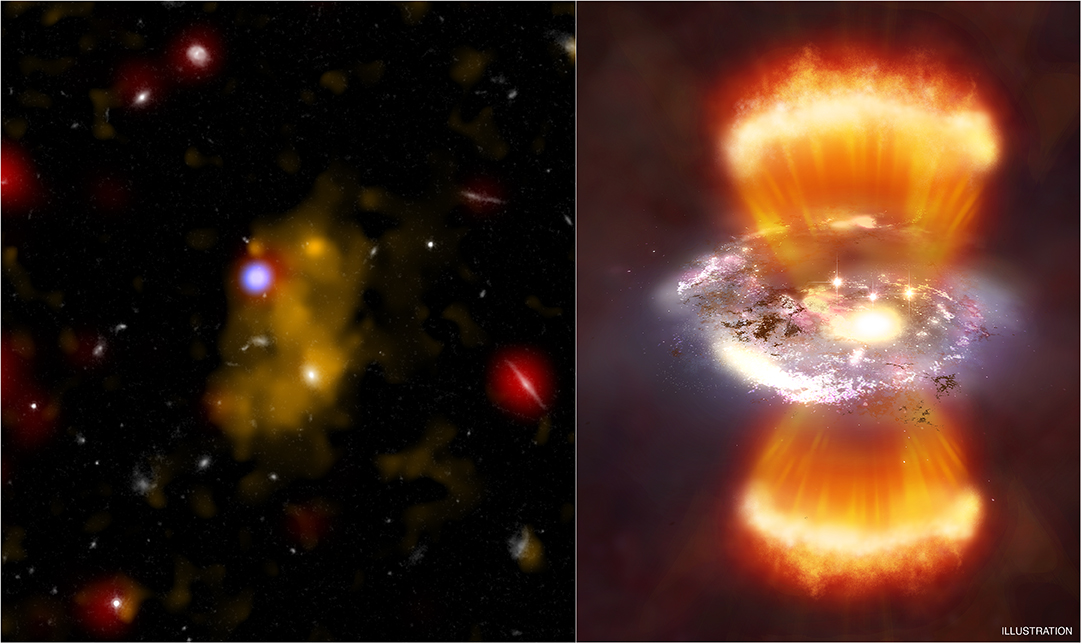
The composite image on the left shows one of the largest blobs observed in this study. Glowing hydrogen gas in the blob is shown by a Lyman-alpha optical image (colored yellow) from the National Astronomy Observatory of Japan's Subaru telescope. A galaxy located in the blob is visible in a broadband optical image (white) from the Hubble Space Telescope and an infrared image from the Spitzer Space Telescope (red). Finally, the Chandra X-ray Observatory image in blue shows evidence for a growing supermassive black hole in the center of the galaxy. Radiation and outflows from this active black hole are powerful enough to light up and heat the gas in the blob. Radiation and winds from rapid star formation occurring in the galaxy is believed to have similar effects. Clear evidence for four other active black holes in blobs is also seen.
The artist's representation on the right shows what one of the galaxies inside a blob might look like if viewed at a relatively close distance. A two-sided outflow powered by the supermassive black hole buried inside the middle of the galaxy is shown in bright yellow, above and below the spiral arms of the galaxy. This outflow illuminates and heats gas surrounding the galaxy. Radiation from regions close to the black hole will also play a significant role in lighting up and heating the blob. Stars are forming at a rapid rate in this galaxy, and young stars are being destroyed in supernova explosions. The three bright stars above the central bulge of the galaxy are examples of such supernovas (a companion illustration shows the effects of such explosions).
These new results show how blobs fit into the cosmic story of how galaxies and black holes evolve. Galaxies are believed to form when gas flows inwards under the pull of gravity and cools by emitting radiation. This process should stop when the gas is heated by radiation and outflows from galaxies and their black holes. Blobs could be a sign of this first stage, or of the second.
Based on the new data and theoretical arguments, Geach and his colleagues show that heating of gas by growing supermassive black holes and bursts of star formation, rather than cooling of gas, most likely powers the blobs. The implication is that blobs represent a stage when the galaxies and black holes are just starting to switch off their rapid growth because of these heating processes. This is a crucial stage of the evolution of galaxies and black holes -- known as "feedback" -- and one that astronomers have long been trying to understand.
Credit: Left panel: X-ray (NASA/CXC/Durham Univ./D.Alexander et al.); Optical (NASA/ESA/STScI/IoA/S.Chapman et al.); Lyman-alpha Optical (NAOJ/Subaru/Tohoku Univ./T.Hayashino et al.); Infrared (NASA/JPL-Caltech/Durham Univ./J.Geach et al.); Right, Illustration: NASA/CXC/M.Weiss
Using Chandra, growing supermassive black holes have been discovered in a sample of blobs, immense reservoirs of hydrogen gas located in the early Universe.
These black holes and bursts of star formation are believed to be illuminating and heating the gas in the blobs.
This represents a "coming of age" for the galaxies and black holes as they start to switch off their rapid growth.
A deep study of 29 gigantic blobs of hydrogen gas has been carried out with NASA's Chandra X-ray Observatory to identify the source of immense energy required to illuminate these structures. These mysterious blobs - called "Lyman-alpha blobs" by astronomers because of the light they emit - are several hundred thousand light years across and are seen when the Universe is only about two billion years old, or about 15% of its current age.
The composite image on the left shows one of the largest blobs observed in this study. Glowing hydrogen gas in the blob is shown by a Lyman-alpha optical image (colored yellow) from the National Astronomy Observatory of Japan's Subaru telescope. A galaxy located in the blob is visible in a broadband optical image (white) from the Hubble Space Telescope and an infrared image from the Spitzer Space Telescope (red). Finally, the Chandra X-ray Observatory image in blue shows evidence for a growing supermassive black hole in the center of the galaxy. Radiation and outflows from this active black hole are powerful enough to light up and heat the gas in the blob. Radiation and winds from rapid star formation occurring in the galaxy is believed to have similar effects. Clear evidence for four other active black holes in blobs is also seen.
The artist's representation on the right shows what one of the galaxies inside a blob might look like if viewed at a relatively close distance. A two-sided outflow powered by the supermassive black hole buried inside the middle of the galaxy is shown in bright yellow, above and below the spiral arms of the galaxy. This outflow illuminates and heats gas surrounding the galaxy. Radiation from regions close to the black hole will also play a significant role in lighting up and heating the blob. Stars are forming at a rapid rate in this galaxy, and young stars are being destroyed in supernova explosions. The three bright stars above the central bulge of the galaxy are examples of such supernovas (a companion illustration shows the effects of such explosions).
These new results show how blobs fit into the cosmic story of how galaxies and black holes evolve. Galaxies are believed to form when gas flows inwards under the pull of gravity and cools by emitting radiation. This process should stop when the gas is heated by radiation and outflows from galaxies and their black holes. Blobs could be a sign of this first stage, or of the second.
Based on the new data and theoretical arguments, Geach and his colleagues show that heating of gas by growing supermassive black holes and bursts of star formation, rather than cooling of gas, most likely powers the blobs. The implication is that blobs represent a stage when the galaxies and black holes are just starting to switch off their rapid growth because of these heating processes. This is a crucial stage of the evolution of galaxies and black holes -- known as "feedback" -- and one that astronomers have long been trying to understand.
Kaydol:
Yorumlar (Atom)