Astronomers Find First Evidence Of Other Universes
Our cosmos was "bruised" in collisions with other universes. Now astronomers have found the first evidence of these impacts in the cosmic microwave background
There's something exciting afoot in the world of cosmology. Last month, Roger Penrose at the University of Oxford and Vahe Gurzadyan at Yerevan State University in Armenia announced that they had found patterns of concentric circles in the cosmic microwave background, the echo of the Big Bang.
This, they say, is exactly what you'd expect if the universe were eternally cyclical. By that, they mean that each cycle ends with a big bang that starts the next cycle. In this model, the universe is a kind of cosmic Russian Doll, with all previous universes contained within the current one.
That's an extraordinary discovery: evidence of something that occurred before the (conventional) Big Bang.
Today, another group says they've found something else in the echo of the Big Bang. These guys start with a different model of the universe called eternal inflation. In this way of thinking, the universe we see is merely a bubble in a much larger cosmos. This cosmos is filled with other bubbles, all of which are other universes where the laws of physics may be dramatically different to ours.
These bubbles probably had a violent past, jostling together and leaving "cosmic bruises" where they touched. If so, these bruises ought to be visible today in the cosmic microwave background.
Now Stephen Feeney at University College London and a few pals say they've found tentative evidence of this bruising in the form of circular patterns in cosmic microwave background. In fact, they've found four bruises, implying that our universe must have smashed into other bubbles at least four times in the past.
Again, this is an extraordinary result: the first evidence of universes beyond our own.
So, what to make of these discoveries. First, these effects could easily be a trick of the eye. As Feeney and co acknowledge: "it is rather easy to fifind all sorts of statistically unlikely properties in a large dataset like the CMB." That's for sure!
There are precautions statisticians can take to guard against this, which both Feeney and Penrose bring to bear in various ways.
But these are unlikely to settle the argument. In the last few weeks, several groups have confirmed Pernose's finding while others have found no evidence for it. Expect a similar pattern for Feeney's result.
The only way to settle this will be to confirm or refute the findings with better data. As luck would have it, new data is forthcoming thanks to the Planck spacecraft that is currently peering into the cosmic microwave background with more resolution and greater sensitivity than ever.
Cosmologists should have a decent data set to play with in a couple of years or so. When they get it, these circles should either spring into clear view or disappear into noise (rather like the mysterious Mars face that appeared in pictures of the red planet taken by Viking 1 and then disappeared in the higher resolution shots from the Mars Global Surveyor).
Planck should settle the matter; or, with any luck, introduce an even better mystery. In the meantime, there's going to be some fascinating discussion about this data and what it implies about the nature of the Universe. We'll be watching.
Ref:
http://arxiv.org/abs/1012.1995: First Observational Tests of Eternal Inflation
http://arxiv.org/abs/1011.3706: Concentric Circles In WMAP Data May Provide Evidence Of Violent Pre-Big-Bang Activity
14 Aralık 2010 Salı


1 Temmuz 2010 Perşembe
X-ray Discovery Points to Location of Missing Matter
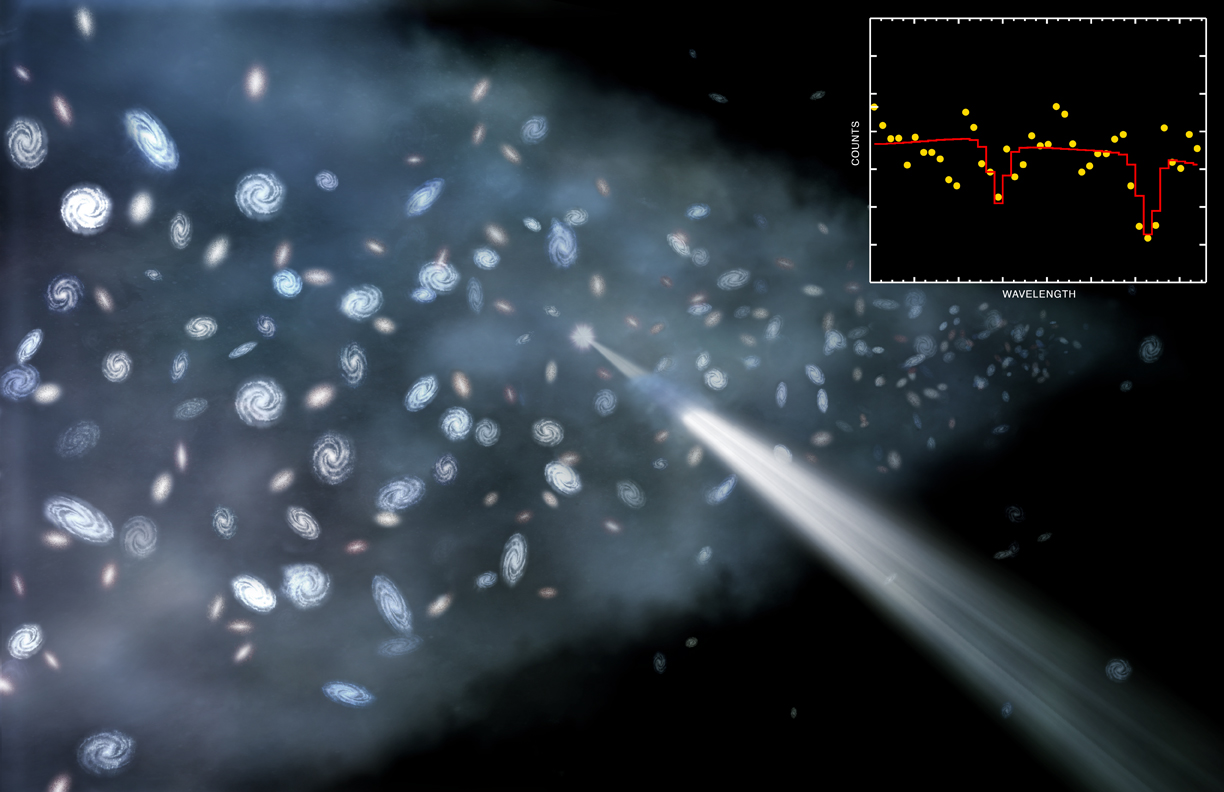
Using observations with NASA's Chandra X-ray Observatory and ESA's XMM-Newton, astronomers have announced a robust detection of a vast reservoir of intergalactic gas about 400 million light years from Earth. This discovery is the strongest evidence yet that the "missing matter" in the nearby Universe is located in an enormous web of hot, diffuse gas.
This missing matter — which is different from dark matter -- is composed of baryons, the particles, such as protons and neutrons, that are found on the Earth, in stars, gas, galaxies, and so on. A variety of measurements of distant gas clouds and galaxies have provided a good estimate of the amount of this "normal matter" present when the universe was only a few billion years old. However, an inventory of the much older, nearby universe has turned up only about half as much normal matter, an embarrassingly large shortfall.
The mystery then is where does this missing matter reside in the nearby Universe? This latest work supports predictions that it is mostly found in a web of hot, diffuse gas known as the Warm-Hot Intergalactic Medium (WHIM). Scientists think the WHIM is material left over after the formation of galaxies, which was later enriched by elements blown out of galaxies.
"Evidence for the WHIM is really difficult to find because this stuff is so diffuse and easy to see right through," said Taotao Fang of the University of California at Irvine and lead author of the latest study. "This differs from many areas of astronomy where we struggle to see through obscuring material."
To look for the WHIM, the researchers examined X-ray observations of a rapidly growing supermassive black hole known as an active galactic nucleus, or AGN. This AGN, which is about two billion light years away, generates immense amounts of X-ray light as it pulls matter inwards.
Lying along the line of sight to this AGN, at a distance of about 400 million light years, is the so-called Sculptor Wall. This "wall", which is a large diffuse structure stretching across tens of millions of light years, contains thousands of galaxies and potentially a significant reservoir of the WHIM if the theoretical simulations are correct. The WHIM in the wall should absorb some of the X-rays from the AGN as they make their journey across intergalactic space to Earth.
Using new data from Chandra and previous observations with both Chandra and XMM-Newton, absorption of X-rays by oxygen atoms in the WHIM has clearly been detected by Fang and his colleagues. The characteristics of the absorption are consistent with the distance of the Sculptor Wall as well as the predicted temperature and density of the WHIM. This result gives scientists confidence that the WHIM will also be found in other large-scale structures.
Several previous claimed detections of the hot component of the WHIM have been controversial because the detections had been made with only one X-ray telescope and the statistical significance of many of the results had been questioned.
"Having good detections of the WHIM with two different telescopes is really a big deal," said co-author David Buote, also from the University of California at Irvine. "This gives us a lot of confidence that we have truly found this missing matter."
In addition to having corroborating data from both Chandra and XMM-Newton, the new study also removes another uncertainty from previous claims. Because the distance of the Sculptor Wall is already known, the statistical significance of the absorption detection is greatly enhanced over previous "blind" searches. These earlier searches attempted to find the WHIM by observing bright AGN at random directions on the sky, in the hope that their line of sight intersects a previously undiscovered large-scale structure.
Confirmed detections of the WHIM have been made difficult because of its extremely low density. Using observations and simulations, scientists calculate the WHIM has a density equivalent to only 6 protons per cubic meter. For comparison, the interstellar medium -- the very diffuse gas in between stars in our galaxy -- typically has about a million hydrogen atoms per cubic meter.
People Who Read This Also Read...
.leftside_bg_Also_visited {
background-image:url(/graphics/ws/podcasts_bg_also_visited.jpg);
background-repeat:repeat-x;
height:36px;
font-size:15px;
font-family:"Bank Gothic";
/*font-variant:small-caps;*/
font-weight:500;
text-align:left;
padding-left:5px;
color:#333333;
}
}
People Who Read This Also Read…-->
Carbon Atmosphere Discovered On Neutron Star
NASA's Great Observatories Celebrate International Year of Astronomy
NASA Celebrates Chandra's 10th Anniversary
Massey Award Given to Harvey Tananbaum
"Evidence for the WHIM has even been much harder to find than evidence for dark matter, which is invisible but can be detected because of its gravitational effects on stars and galaxies," said Fang.
There have been important detections of possible WHIM in the nearby Universe with relatively low temperatures of about 100,000 degrees using ultraviolet observations and relatively high temperature WHIM of about 10 million degrees using observations of X-ray emission in galaxy clusters. However, these are expected to account for only a relatively small fraction of the WHIM. The X-ray absorption studies reported here probe temperatures of about a million degrees where most of the WHIM is predicted to be found.
These results appear in the May 10th issue of The Astrophysical Journal. NASA's Marshall Space Flight Center in Huntsville, Ala., manages the Chandra program for NASA's Science Mission Directorate in Washington. The Smithsonian Astrophysical Observatory controls Chandra's science and flight operations from Cambridge, Mass.
More information, including images and other multimedia, can be found at:http://chandra.harvard.edu/ and http://chandra.nasa.gov/
CID-42:
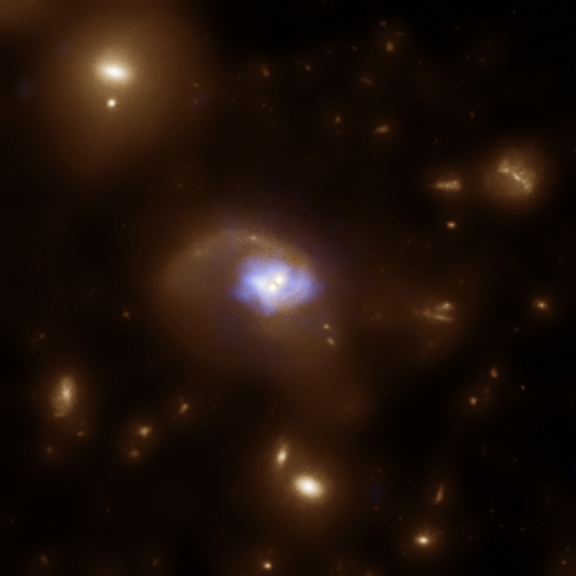
An unusual object was discovered in the Cosmic Evolution Survey, a large multi-wavelength study.
This object, known as CID-42, is the only one out of the 2,600 in the survey that has two very close compact objects seen in optical light.
By combining data from Chandra and other telescopes, evidence is found for a recoiling black hole in the system.
Two different scenarios for this possible recoiling black hole are being pursued.
Evidence for a recoiling black hole has been found using data from the Chandra X-ray Observatory, XMM-Newton, the Hubble Space Telescope (HST), and several ground-based telescopes. A new paper reports that this black hole kickback was caused either by a slingshot effect produced in a triple black hole system, or from the effects of gravitational waves produced after two supermassive black holes merged a few million years earlier.
The discovery of this object, located in this composite image, comes from a large, multi-wavelength survey, known as the Cosmic Evolution Survey (COSMOS). This survey includes data from Chandra, HST, XMM-Newton, as well as ground-based observatories. Of the 2,600 X-ray sources found in COSMOS, only one -- named CID-42 and located in a galaxy about 3.9 billion light years away -- coincides with two very close, compact optical sources. In this image, the X-ray source detected by Chandra is colored blue, while the Hubble data are seen in gold. The two white sources near the center of the image are seen in the optical HST data, but they are too close for Chandra to resolve them separately.
The galaxy's long tail suggests that a merger between galaxies has occurred relatively recently, only a few million years earlier. Data from the Very Large Telescope and the Magellan telescope give evidence that there is a large difference in speed between the two optical sources of at least about three million miles an hour.
The X-ray spectra from Chandra and XMM-Newton provide extra information about CID-42. Absorption from iron-rich gas shows that gas is moving rapidly away from us in the rest frame of the galaxy. This could be gas in the galaxy between us and one of the black holes that is falling into the black hole, or it could be gas on the far side of the black hole that is blowing away.
Taken together, these pieces of information allow for two different scenarios for what is happening in this system and the nature of the two optical sources in the center of the image. In the first scenario, the researchers surmise that a triple black hole encounter was produced by a two-step process. First, a collision between two galaxies created a galaxy with a pair of black holes in a close orbit. Before these black holes could merge, another galaxy collision occurred, and another supermassive black hole spiraled toward the existing black hole pair.
The interaction among the three black holes resulted in the lightest one being ejected. In this case, the source in the lower left of the central pair of optical sources is an active galactic nucleus (AGN) powered by material being pulled along by, and falling onto, the escaping supermassive black hole. The source in the upper right of the central pair is an AGN containing the black hole that resulted from a merger between the two remaining black holes.
In this slingshot scenario, the high-speed X-ray absorption can be explained as a high-speed wind blowing away from the AGN in the upper right that absorbs light from the AGN in the lower left. Based on its optical spectrum, the AGN in the upper right is thought to be obscured by a torus of dust and gas. In nearly all cases a wind from such an AGN would be undetectable, but here it is illuminated by the other AGN, giving the first evidence that fast winds exist in obscured AGN.
An alternative explanation posits a merger between two supermassive black holes in the center of the galaxy. The asymmetry of the gravitational waves emitted in this process caused the merged black hole to be kicked away from the center of the galaxy. In this scenario, the ejected black hole is the point source in the lower left of the central pair and a cluster of stars left behind in the center of the galaxy is in the upper right. The observed X-ray absorption would be caused by gas falling onto the recoiling black hole.
Future observations may help eliminate or further support one of these scenarios. A team of researchers led by Francesca Civano and Martin Elvis of the Harvard-Smithsonian Center for Astrophysics (CfA) will publish their work on CID-42 in the July 1st edition of The Astrophysical Journal.
The second scenario, concerning the recoil of a supermassive black hole caused by a gravitational wave kick, has recently been proposed by Peter Jonker from the Netherlands Institute for Space Research in Utrecht as a possible explanation for a source in a different galaxy. In this study, led by Peter Jonker from the Netherlands Institute for Space Research in Utrecht, a Chandra X-ray source was discovered about ten thousand light years, in projection, away from the center of a galaxy. Three possible explanations for this object are that it is an unusual type of supernova, or an ultraluminous X-ray source with a very bright optical counterpart or a recoiling supermassive black hole resulting from a gravitational wave kick.
This object, known as CID-42, is the only one out of the 2,600 in the survey that has two very close compact objects seen in optical light.
By combining data from Chandra and other telescopes, evidence is found for a recoiling black hole in the system.
Two different scenarios for this possible recoiling black hole are being pursued.
Evidence for a recoiling black hole has been found using data from the Chandra X-ray Observatory, XMM-Newton, the Hubble Space Telescope (HST), and several ground-based telescopes. A new paper reports that this black hole kickback was caused either by a slingshot effect produced in a triple black hole system, or from the effects of gravitational waves produced after two supermassive black holes merged a few million years earlier.
The discovery of this object, located in this composite image, comes from a large, multi-wavelength survey, known as the Cosmic Evolution Survey (COSMOS). This survey includes data from Chandra, HST, XMM-Newton, as well as ground-based observatories. Of the 2,600 X-ray sources found in COSMOS, only one -- named CID-42 and located in a galaxy about 3.9 billion light years away -- coincides with two very close, compact optical sources. In this image, the X-ray source detected by Chandra is colored blue, while the Hubble data are seen in gold. The two white sources near the center of the image are seen in the optical HST data, but they are too close for Chandra to resolve them separately.
The galaxy's long tail suggests that a merger between galaxies has occurred relatively recently, only a few million years earlier. Data from the Very Large Telescope and the Magellan telescope give evidence that there is a large difference in speed between the two optical sources of at least about three million miles an hour.
The X-ray spectra from Chandra and XMM-Newton provide extra information about CID-42. Absorption from iron-rich gas shows that gas is moving rapidly away from us in the rest frame of the galaxy. This could be gas in the galaxy between us and one of the black holes that is falling into the black hole, or it could be gas on the far side of the black hole that is blowing away.
Taken together, these pieces of information allow for two different scenarios for what is happening in this system and the nature of the two optical sources in the center of the image. In the first scenario, the researchers surmise that a triple black hole encounter was produced by a two-step process. First, a collision between two galaxies created a galaxy with a pair of black holes in a close orbit. Before these black holes could merge, another galaxy collision occurred, and another supermassive black hole spiraled toward the existing black hole pair.
The interaction among the three black holes resulted in the lightest one being ejected. In this case, the source in the lower left of the central pair of optical sources is an active galactic nucleus (AGN) powered by material being pulled along by, and falling onto, the escaping supermassive black hole. The source in the upper right of the central pair is an AGN containing the black hole that resulted from a merger between the two remaining black holes.
In this slingshot scenario, the high-speed X-ray absorption can be explained as a high-speed wind blowing away from the AGN in the upper right that absorbs light from the AGN in the lower left. Based on its optical spectrum, the AGN in the upper right is thought to be obscured by a torus of dust and gas. In nearly all cases a wind from such an AGN would be undetectable, but here it is illuminated by the other AGN, giving the first evidence that fast winds exist in obscured AGN.
An alternative explanation posits a merger between two supermassive black holes in the center of the galaxy. The asymmetry of the gravitational waves emitted in this process caused the merged black hole to be kicked away from the center of the galaxy. In this scenario, the ejected black hole is the point source in the lower left of the central pair and a cluster of stars left behind in the center of the galaxy is in the upper right. The observed X-ray absorption would be caused by gas falling onto the recoiling black hole.
Future observations may help eliminate or further support one of these scenarios. A team of researchers led by Francesca Civano and Martin Elvis of the Harvard-Smithsonian Center for Astrophysics (CfA) will publish their work on CID-42 in the July 1st edition of The Astrophysical Journal.
The second scenario, concerning the recoil of a supermassive black hole caused by a gravitational wave kick, has recently been proposed by Peter Jonker from the Netherlands Institute for Space Research in Utrecht as a possible explanation for a source in a different galaxy. In this study, led by Peter Jonker from the Netherlands Institute for Space Research in Utrecht, a Chandra X-ray source was discovered about ten thousand light years, in projection, away from the center of a galaxy. Three possible explanations for this object are that it is an unusual type of supernova, or an ultraluminous X-ray source with a very bright optical counterpart or a recoiling supermassive black hole resulting from a gravitational wave kick.
20 Mayıs 2010 Perşembe
Can a Black Hole Have an 'Aurora'?
As our telescopes become more powerful, we are able to see more exotic cosmic objects. Eventually, we may even be able to take a snapshot of the supermassive black hole living in the center of our galaxy, but what will we see? According to two Japanese researchers, we might be able to spot a black hole 'aurora.'
But this isn't your average aurora.
When the solar wind slams into the Earth's atmosphere, the solar plasma (made up mainly of high-energy protons) hit air molecules, kicking off some light. When you have a lot of these collisions in the upper atmosphere, the sky will light up as an aurora.
However, a black hole doesn't have an atmosphere, so how can an aurora be generated?
SLIDE SHOW: Aurorae on Earth are caused by solar storms, browse the Discovery News pick of some of the most spectacular photos of this beautiful sun-Earth interaction.
Kasey-Dee Gardner speaks with the astronomer who discovered the supermassive black hole at the center of our galaxy.
Spin It, Feed It
Masaaki Takahashi, from Aichi University of Education, Kariya, and Rohta Takahashi, from the Institute of Physical and Chemical Research, Wako, started out by modeling a rapidly spinning black hole.
As black holes have a massive gravitational pull, they will suck in any dust, gas or even stars that stray too close. If you have a spinning black hole, it's predicted to form a disk of hot radiating plasma around its equator. This is called an 'accretion disk.'
As the disk will contain charged particles, it's possible that a magnetic field will be generated -- much like the internal dynamo of the Earth, generating the magnetic field of our magnetosphere.
In their paper, published in The Astrophysical Journal Letters last month, Takahashi and Takahashi's model predicts a black hole 'magnetosphere' is generated where the magnetic field lines thread through the accretion disk and get dragged into the poles of the black hole's event horizon.
Now we have a black hole with its own magnetosphere, and like the Earth's magnetosphere, space plasma will be funneled along the magnetic field lines -- like water being pumped through a fire hose.
But this is no ordinary fire hose.
Shocked Plasma
The plasma flow will be so fast when being funneled into the event horizon that it will break the plasma 'sound barrier' (exceeding what is known as the Alfven speed).
This is when the black hole 'aurora' might be generated. In a similar way to a supersonic aircraft breaking the sound barrier in our atmosphere (producing a sonic boom), the supersonic plasma will create a shock. The Japanese researchers found that this shock will form a halo, crowning the black hole's poles, just above the event horizon. As the plasma hits this shock it releases energy, rapidly heating up and generating light.
This all sounds very exciting, but this model is purely theoretical. A black hole 'aurora' could never be observed, right?
Actually, this is why I find this black hole aurora research so cool.
Shadow of the Beast
Using several networked observatories around the globe, a technique known as "very long baseline interferometry" (or "VLBI") could be used to directly image the Milky Way's supermassive black hole (something that isn't currently possible). As this is the largest black hole nearby, its event horizon should be big enough to see, assuming enough observatories are included in a future VLBI campaign.
Assuming this can be achieved, the "shadow" of the black hole's event horizon (a dark circle) might be visible.
A modeled black hole shadow (left) and two simulated observations of the Milky Way's supermassive black hole using a 7-telescope and 13-telescope array (Fish & Doeleman)
In a 2009 study carried out by Vincent Fish and Sheperd Doeleman of the MIT Haystack Observatory, Mass., a VLBI campaign was simulated and the results were striking (the modeled black hole shadow is pictured here).
If we are able to network enough radio telescopes around the globe as an international VLBI campaign, the emissions from the black hole 'aurora' might also be resolved.
However, the researchers are unsure about the type of radiation produced by the shocked plasma; it would depend on the magnetic conditions near the black hole's event horizon. But should the conditions be extreme enough, this model may be used to explain the voracious black holes residing inside active galactic nuclei.
"Such a black hole magnetosphere may be considered as a model for the central engine of active galactic nuclei, some compact X-ray sources and gamma-ray bursts." -- Takahashi and Takahashi, 2010
The Fingerprint of Extreme Curvature
There's another aspect to hunting for a black hole's aurora: the powerful radiation generated so close to the black hole's event horizon would reveal some very useful information about this extreme space-time environment.
The event horizon is the point of no return, the boundary where even light cannot escape from the extreme curvature of space-time caused by the immense gravitational dominance of the black hole.
But as the plasma shocks predicted by the Japanese researchers generates aurorae-like light just above the event horizon, some of that radiation will escape from the clutches of the event horizon, allowing future radio astronomers a peek into the mysterious phenomena that are thought to surround black holes.
One phenomenon that comes to mind is "frame dragging" (also known as the Lense-Thirring effect), when a massive spinning object drags the neighboring space-time with it. If we could find a way to "see" the light from a black hole aurora, perhaps we'll be able to detect the fingerprint of frame dragging too.
Although it's likely to be a long time before VLBI becomes sensitive enough to detect a black hole's aurora-like radiation (if it even exists), it is certainly a very exciting study with the potential of probing within a hair's-breadth from the event horizon of the Milky Way's supermassive black hole.
Publication: Black Hole Aurora powered by a Rotating Black Hole, Masaaki Takahashi and Rohta Takahashi 2010 ApJ 714 L176.
arXiv pre-print: arXiv:1004.0076v1 [astro-ph.HE]
Leading image: My interpretation as to how a black hole's aurora might look like close up (Ian O'Neill/Discovery News).
But this isn't your average aurora.
When the solar wind slams into the Earth's atmosphere, the solar plasma (made up mainly of high-energy protons) hit air molecules, kicking off some light. When you have a lot of these collisions in the upper atmosphere, the sky will light up as an aurora.
However, a black hole doesn't have an atmosphere, so how can an aurora be generated?
SLIDE SHOW: Aurorae on Earth are caused by solar storms, browse the Discovery News pick of some of the most spectacular photos of this beautiful sun-Earth interaction.
Kasey-Dee Gardner speaks with the astronomer who discovered the supermassive black hole at the center of our galaxy.
Spin It, Feed It
Masaaki Takahashi, from Aichi University of Education, Kariya, and Rohta Takahashi, from the Institute of Physical and Chemical Research, Wako, started out by modeling a rapidly spinning black hole.
As black holes have a massive gravitational pull, they will suck in any dust, gas or even stars that stray too close. If you have a spinning black hole, it's predicted to form a disk of hot radiating plasma around its equator. This is called an 'accretion disk.'
As the disk will contain charged particles, it's possible that a magnetic field will be generated -- much like the internal dynamo of the Earth, generating the magnetic field of our magnetosphere.
In their paper, published in The Astrophysical Journal Letters last month, Takahashi and Takahashi's model predicts a black hole 'magnetosphere' is generated where the magnetic field lines thread through the accretion disk and get dragged into the poles of the black hole's event horizon.
Now we have a black hole with its own magnetosphere, and like the Earth's magnetosphere, space plasma will be funneled along the magnetic field lines -- like water being pumped through a fire hose.
But this is no ordinary fire hose.
Shocked Plasma
The plasma flow will be so fast when being funneled into the event horizon that it will break the plasma 'sound barrier' (exceeding what is known as the Alfven speed).
This is when the black hole 'aurora' might be generated. In a similar way to a supersonic aircraft breaking the sound barrier in our atmosphere (producing a sonic boom), the supersonic plasma will create a shock. The Japanese researchers found that this shock will form a halo, crowning the black hole's poles, just above the event horizon. As the plasma hits this shock it releases energy, rapidly heating up and generating light.
This all sounds very exciting, but this model is purely theoretical. A black hole 'aurora' could never be observed, right?
Actually, this is why I find this black hole aurora research so cool.
Shadow of the Beast
Using several networked observatories around the globe, a technique known as "very long baseline interferometry" (or "VLBI") could be used to directly image the Milky Way's supermassive black hole (something that isn't currently possible). As this is the largest black hole nearby, its event horizon should be big enough to see, assuming enough observatories are included in a future VLBI campaign.
Assuming this can be achieved, the "shadow" of the black hole's event horizon (a dark circle) might be visible.
A modeled black hole shadow (left) and two simulated observations of the Milky Way's supermassive black hole using a 7-telescope and 13-telescope array (Fish & Doeleman)
In a 2009 study carried out by Vincent Fish and Sheperd Doeleman of the MIT Haystack Observatory, Mass., a VLBI campaign was simulated and the results were striking (the modeled black hole shadow is pictured here).
If we are able to network enough radio telescopes around the globe as an international VLBI campaign, the emissions from the black hole 'aurora' might also be resolved.
However, the researchers are unsure about the type of radiation produced by the shocked plasma; it would depend on the magnetic conditions near the black hole's event horizon. But should the conditions be extreme enough, this model may be used to explain the voracious black holes residing inside active galactic nuclei.
"Such a black hole magnetosphere may be considered as a model for the central engine of active galactic nuclei, some compact X-ray sources and gamma-ray bursts." -- Takahashi and Takahashi, 2010
The Fingerprint of Extreme Curvature
There's another aspect to hunting for a black hole's aurora: the powerful radiation generated so close to the black hole's event horizon would reveal some very useful information about this extreme space-time environment.
The event horizon is the point of no return, the boundary where even light cannot escape from the extreme curvature of space-time caused by the immense gravitational dominance of the black hole.
But as the plasma shocks predicted by the Japanese researchers generates aurorae-like light just above the event horizon, some of that radiation will escape from the clutches of the event horizon, allowing future radio astronomers a peek into the mysterious phenomena that are thought to surround black holes.
One phenomenon that comes to mind is "frame dragging" (also known as the Lense-Thirring effect), when a massive spinning object drags the neighboring space-time with it. If we could find a way to "see" the light from a black hole aurora, perhaps we'll be able to detect the fingerprint of frame dragging too.
Although it's likely to be a long time before VLBI becomes sensitive enough to detect a black hole's aurora-like radiation (if it even exists), it is certainly a very exciting study with the potential of probing within a hair's-breadth from the event horizon of the Milky Way's supermassive black hole.
Publication: Black Hole Aurora powered by a Rotating Black Hole, Masaaki Takahashi and Rohta Takahashi 2010 ApJ 714 L176.
arXiv pre-print: arXiv:1004.0076v1 [astro-ph.HE]
Leading image: My interpretation as to how a black hole's aurora might look like close up (Ian O'Neill/Discovery News).
11 Şubat 2010 Perşembe
Top 10 Favorites
NGC 4565. An edge-on spiral galaxy in the constellation Coma Berenices. Some 55 million light years away, this galaxy looks like a frosty needle in the depths of intergalactic space. Some also call it the "Flying Saucer" galaxy. Visible in a 6-8 inch (or larger) telescope.
The Double Cluster. A unique set of two rich open star clusters in the constellation Perseus. Visible as a fuzzy patch to the naked eye, this pair is stunningly beautiful in a telescope. Easy to see, not to be missed.
The Castaway Cluster. Set in the most star-rich section of the Milky Way and surrounded by dark nebulae that look like holes in space itself, the "Castaway Cluster" is an achingly beautiful sight. It's located just above the spout of the "
Teapot" of Sagittarius. Also known as NGC 6520, this cluster was named by astronomy writer Stephen J. O'Meara because it looks like a tiny island in a tempestuous sea of stars. It reminded him of the story of the castaway Robinson Crusoe.
The Veil Nebula. A system of three ethereal nebulae in the constellation Cygnus. They were formed by the supernova explosion of one (and possibly two) stars some 18,000 years ago. The Veil spans more than 3 degrees of sky, and is hard to fit into a single field of view of a telescope.
A stunning sight, just off the star epsilon Cygni. Can be seen in binoculars in very dark sky.The "
E.T. Cluster". In Cassiopeia, this small open cluster is also cataloged as NGC 457. Its name comes from a more-than-passing resemblance to the famed character in Steven Spielberg's "E.T.". Visible from northern skies only.
The Jewel Box Cluster. A dazzling open star cluster in the Crux (the Southern Cross), it appears as a fuzzy star just off the star Mimosa at one arm of the cross. Early astronomers actually catalogued this cluster as a star, kappa Crucis, before telescopes revealed its true nature. Binoculars or a small scope are all you need to see this young cluster full of new blue-white stars.
47 Tucanae. The second brightest globular cluster in the sky, but perhaps the most visually appealing. This cluster is as old as the Milky Way itself... some 12 billion years. You can see it in the deep-southern constellation Tucana with your unaided eye. It looks like a bundle of diamonds in even the smallest telescope.
M11. A large, old open star cluster in Scutum, M11 is sometimes called the "Wild Duck" cluster because of its resemblance to a flock of ducks or geese flying in a V-shaped formation. Observe it with low magnification and work your way higher. But take your time... see as much detail as you can.M22. A loosely-packed globular cluster in Sagittarius. Called by some the "Arkenstone of the Sky", M22 is a lovely sight on a warm northern summer night. One of the finest sights in a constellation packed with fine sights.
NGC 5128. A giant elliptical galaxy caught in the act of eating a dusty edge-on spiral galaxy, NGC 5128 in the southern constellation Centaurus is one of the most intriguing galaxies in the heavens.
The Double Cluster. A unique set of two rich open star clusters in the constellation Perseus. Visible as a fuzzy patch to the naked eye, this pair is stunningly beautiful in a telescope. Easy to see, not to be missed.
The Castaway Cluster. Set in the most star-rich section of the Milky Way and surrounded by dark nebulae that look like holes in space itself, the "Castaway Cluster" is an achingly beautiful sight. It's located just above the spout of the "
Teapot" of Sagittarius. Also known as NGC 6520, this cluster was named by astronomy writer Stephen J. O'Meara because it looks like a tiny island in a tempestuous sea of stars. It reminded him of the story of the castaway Robinson Crusoe.
The Veil Nebula. A system of three ethereal nebulae in the constellation Cygnus. They were formed by the supernova explosion of one (and possibly two) stars some 18,000 years ago. The Veil spans more than 3 degrees of sky, and is hard to fit into a single field of view of a telescope.
A stunning sight, just off the star epsilon Cygni. Can be seen in binoculars in very dark sky.The "
E.T. Cluster". In Cassiopeia, this small open cluster is also cataloged as NGC 457. Its name comes from a more-than-passing resemblance to the famed character in Steven Spielberg's "E.T.". Visible from northern skies only.
The Jewel Box Cluster. A dazzling open star cluster in the Crux (the Southern Cross), it appears as a fuzzy star just off the star Mimosa at one arm of the cross. Early astronomers actually catalogued this cluster as a star, kappa Crucis, before telescopes revealed its true nature. Binoculars or a small scope are all you need to see this young cluster full of new blue-white stars.
47 Tucanae. The second brightest globular cluster in the sky, but perhaps the most visually appealing. This cluster is as old as the Milky Way itself... some 12 billion years. You can see it in the deep-southern constellation Tucana with your unaided eye. It looks like a bundle of diamonds in even the smallest telescope.
M11. A large, old open star cluster in Scutum, M11 is sometimes called the "Wild Duck" cluster because of its resemblance to a flock of ducks or geese flying in a V-shaped formation. Observe it with low magnification and work your way higher. But take your time... see as much detail as you can.M22. A loosely-packed globular cluster in Sagittarius. Called by some the "Arkenstone of the Sky", M22 is a lovely sight on a warm northern summer night. One of the finest sights in a constellation packed with fine sights.
NGC 5128. A giant elliptical galaxy caught in the act of eating a dusty edge-on spiral galaxy, NGC 5128 in the southern constellation Centaurus is one of the most intriguing galaxies in the heavens.
9 Şubat 2010 Salı
New Findings on Hot Quark Soup Produced at RHIC
New Findings on Hot Quark Soup Produced at RHIC
Scientists to present latest findings from heavy ion collisions at APS meeting
Scientists to present latest findings from heavy ion collisions at APS meeting

EVENT: Scientists from the U.S. Department of Energy’s Brookhaven National Laboratory and the Relativistic Heavy Ion Collider (RHIC), the world’s largest particle accelerator dedicated to nuclear physics research, will present compelling new findings about the nature of the “perfect” liquid created in near-light-speed collisions of gold ions at RHIC.
WHEN: Monday, February 15, 2010, 9:30 a.m.
WHERE: The "April 2010" meeting of the American Physical Society (APS), Marriott Wardman Park Hotel, Washington, D.C., Press Room/Briefing Room, Park Tower 8222
DETAILS: The Relativistic Heavy Ion Collider (RHIC) is a 2.4-mile-circumference particle accelerator/collider that has been operating at Brookhaven Lab since 2000, delivering collisions of heavy ions, protons, and other particles to an international team of physicists investigating the basic structure and fundamental forces of matter. In 2005, RHIC physicists announced that the matter created in RHIC’s most energetic collisions behaves like a nearly “perfect” liquid in that it has extraordinarily low viscosity, or resistance to flow. Since then, the scientists have been taking a closer look at this remarkable form of matter, which last existed some 13 billion years ago, a mere fraction of a second after the Big Bang. At this press event, scientists will present new findings, including the first measurement of temperature very early in the collision events, and their implications for the nature of this early-universe matter.
WHEN: Monday, February 15, 2010, 9:30 a.m.
WHERE: The "April 2010" meeting of the American Physical Society (APS), Marriott Wardman Park Hotel, Washington, D.C., Press Room/Briefing Room, Park Tower 8222
DETAILS: The Relativistic Heavy Ion Collider (RHIC) is a 2.4-mile-circumference particle accelerator/collider that has been operating at Brookhaven Lab since 2000, delivering collisions of heavy ions, protons, and other particles to an international team of physicists investigating the basic structure and fundamental forces of matter. In 2005, RHIC physicists announced that the matter created in RHIC’s most energetic collisions behaves like a nearly “perfect” liquid in that it has extraordinarily low viscosity, or resistance to flow. Since then, the scientists have been taking a closer look at this remarkable form of matter, which last existed some 13 billion years ago, a mere fraction of a second after the Big Bang. At this press event, scientists will present new findings, including the first measurement of temperature very early in the collision events, and their implications for the nature of this early-universe matter.
6 Ocak 2010 Çarşamba
Hubble telescope shows earliest photo of universe

Hubble telescope shows earliest photo of universe
WASHINGTON – The Hubble Space Telescope has captured the earliest image yet of the universe — just 600 million years after the Big Bang, when the universe was just a toddler.
Scientists released the photo Tuesday at a meeting of the American Astronomical Society. It's the most complete picture of the early universe so far, showing galaxies with stars that are already hundreds of millions of years old, along with the unmistakable primordial signs of the first cluster of stars.
These young galaxies haven't yet formed their familiar spiral or elliptical shapes and are much smaller and quite blue in color. That's mostly because at this stage, they don't contain many heavy metals, said Garth Illingworth, a University of California, Santa Cruz, astronomy professor who was among those releasing the photo.
"We're seeing very small galaxies that are seeds of the great galaxies today," Illingworth said in a news conference.
Until NASA's Hubble telescope was repaired and upgraded last year, the farthest back in time that astronomers could see was about 900 million years after the Big Bang, Illingworth said. Hubble has been key in helping determine the age of the universe at about 13.7 billion years, ending a long scientific debate about a decade ago.
As far back as Hubble can see, it still doesn't see the first galaxies. For that, NASA will have to rely on a new observatory, the $4.5 billion James Webb telescope, which is set to launch in about four years.
"We are on the way to the beginning," said astrophysicist Neil deGrasse Tyson of the American Museum of Natural History. "Every step closer to the beginning tells you something you did not know before."
The new Hubble picture captures those distant simpler galaxies juxtaposed amid closer, newer and more evolved ones. The result is a cosmic family photo that portrays galaxies at different ages and stages of development over the course of more than 13 billion years.
Tyson, who was not involved in the Hubble image research, said most people only like their own baby pictures, but Hubble's photo is different: "These are the baby pictures for us all, hence the widespread interest."
___
On the Net:
Hubble Space Telescope: http://us.rd.yahoo.com/dailynews/ap/ap_on_sc/storytext/us_sci_hubble_photo/34628531/SIG=10os459fg/*http://hubblesite.org/
Kaydol:
Yorumlar (Atom)

